




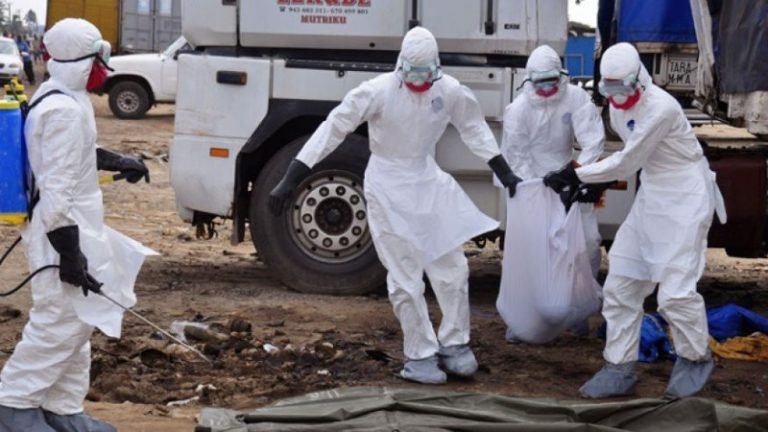
Uganda has confirmed three new cases of Ebola, raising the total number of infections linked to the latest outbreak in the country to five.
The announcement was made on Saturday by the Ugandan health ministry, days after the World Health Organization (WHO) raised the Ebola risk level in neighbouring Democratic Republic of Congo (DRC) to “very high”.
According to the ministry, the newly confirmed cases involve a Ugandan driver, a Ugandan health worker, and a Congolese woman. All three patients are alive and receiving medical attention.
Authorities said the driver had transported one of the infected Congolese nationals who recently crossed into Uganda, while the health worker contracted the virus while treating the patient.
The Congolese woman had reportedly sought treatment in Kampala for abdominal pain before returning to the DRC, where she later tested positive for Ebola.
Uganda suspended all public transport links with the DRC on Thursday after confirming its first two cases linked to Congolese nationals — one infection and one death.
The health ministry said all individuals who came into contact with the confirmed patients had been identified and placed under close monitoring.
The WHO on Friday warned that the Ebola situation in the DRC was becoming increasingly difficult to contain, particularly in insecure and remote areas where health officials are struggling to trace contacts and contain the spread.
The current outbreak has so far recorded 82 confirmed cases and seven confirmed deaths in the DRC, alongside hundreds of suspected infections and fatalities.
Health experts believe the virus may have been spreading undetected for some time before the outbreak was formally identified.
The outbreak is linked to the Bundibugyo strain of Ebola, a less common variant for which there are currently no approved vaccines or treatments.
The epicentre of the outbreak is in eastern DRC, a region affected by years of armed conflict involving multiple militant groups, including the Rwanda-backed M23 militia.
The WHO has maintained that the global risk remains low despite the growing regional threat in Central Africa.