

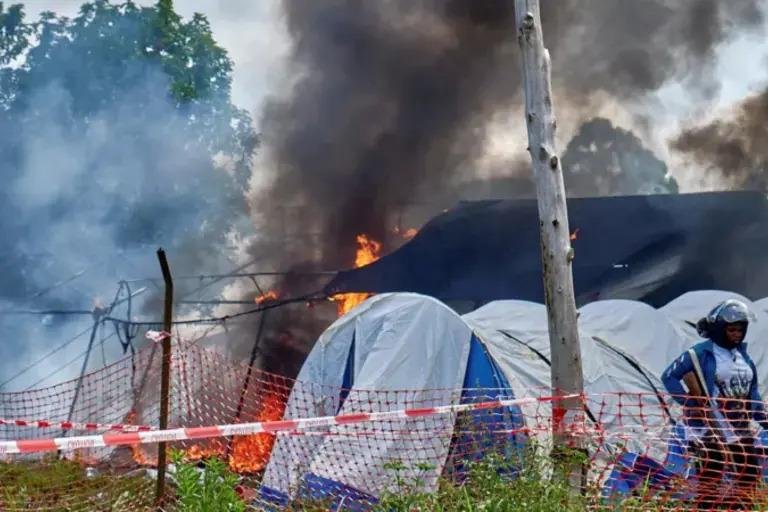
An irate crowd set fire to a section of a hospital near the core of the Ebola outbreak in the eastern Democratic Republic of Congo when family and friends of a young man assumed to have died from the virus were barred from taking his body away for burial.
They began firing objects toward the hospital. They also set fire to tents used as isolation wards,” local politician Luc Malembe Malembe told the BBC about what he saw at Rwampara General Hospital.
During the tumult, police fired warning bullets to disperse the gathering.
The body of a dead Ebola victim is very contagious, and officials must arrange a safe burial to prevent the infection from spreading.
Medical staff at the Rwampara hospital, near the city of Bunia in Ituri Province, where practically all of the cases have been documented, were placed under military protection when police arrived to restore order.
Before law enforcement arrived, stone-throwing demonstrators harmed a healthcare worker, according to a hospital employee.
The man who died was a well-known figure in the town, and people who were grieved by his death did not “grasp the reality of the disease,” according to Jean Claude Mukendi, who is in charge of Ituri’s security response to Ebola.
Witnesses told Reuters that the young man was a player who had played for several local teams. His mother informed the news agency that she felt her son died from typhoid disease, not Ebola.
Malembe said the crowd did not think the virus, which has killed over 130 people in eastern DR Congo, was real.
“People are not properly informed or sensitized about what is happening. “For a certain segment of the population, especially in remote areas, Ebola is an invention by outsiders—it does not exist,” the politician said.
“They believe it is the NGOs and hospitals creating this to make money, and this is tragic.”
He stated that two tents had been burned down, as well as a body that was scheduled to be buried.
Congolese Foreign Minister Thérèse Kayikwamba Wagner described the situation as a “very frightening situation” for communities.
“I think it is normal, and it would be normal in any setting that all sorts of reactions are triggered, including challenging or questioning narratives that they might not feel comfortable with,” she told the BBC’s Newsday program.
She went on to explain that authorities were “ramping up” their work in affected areas to make populations feel protected, understood, and heard.
The World Health Organization (WHO) advocates “safe and dignified burials” for Ebola victims, with trained teams handling the bodies with protective equipment.
Six patients were receiving treatment in tents on the hospital grounds, and it was rumored that they may have fled during the chaos.
But according to the medical organization Alima, which purportedly ran the tents, they are all accounted for and “are currently being cared for at the hospital.”
The chaos began after it was stated that the DR Congo national football team’s pre-World Cup training camp in the capital, Kinshasa, had been cancelled due to the outbreak.
The WHO has declared it a “public health emergency of international concern,” but not a pandemic.
The WHO reported on Wednesday that 139 persons in the Democratic Republic of the Congo were believed to have died from Ebola, out of 600 suspected cases.
However, on the same day, Congolese Health Minister Samuel Roger Kamba informed official channel RTNC TV that authorities had recorded 159 deaths.
Uganda, DR Congo’s neighbor, has detected two instances of the virus.
As a result of the epidemic, the authorities have temporarily banned all flights, buses, and other forms of public transportation across the border.
Passenger ferries are likewise not permitted on the Semliki River, which forms part of the boundary between the Democratic Republic of the Congo and Uganda.
The outbreak was caused by Bundibugyo, a rare type of Ebola. There is presently no vaccine for this species, and the WHO estimates that it could take up to nine months to develop one.
On Thursday, the M23 rebel group, which controls sections of eastern DR Congo, verified the first case of Ebola in South Kivu province, hundreds of kilometers from the hotspot in Ituri.
According to a rebel statement, the 28-year-old who had traveled from Kisangani died before the diagnosis could be confirmed.
Kisangani is a big city in north-central Tshopo province where no Ebola cases have been reported.
There is rising worry over access to M23-controlled territories.
The organization has never handled a crisis like Ebola but has stated that it will collaborate with international partners to contain the epidemic.