




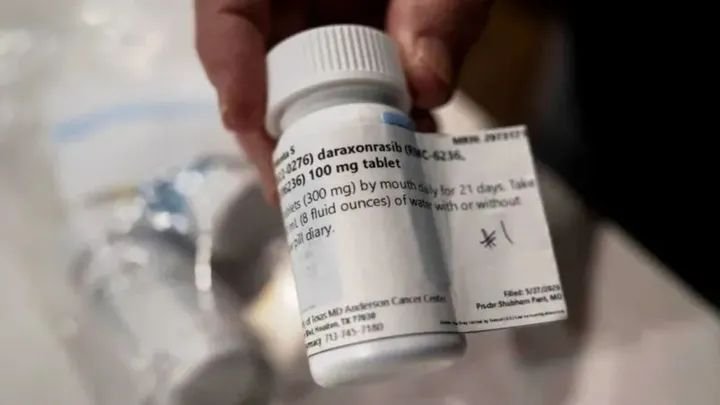
The US Food and Drug Administration (FDA) has approved Rasonque, a groundbreaking new drug from Revolution Medicines for adults with metastatic pancreatic cancer, offering a major new treatment option for patients with the aggressive disease.
The once-daily tablet, whose generic name is daraxonrasib, was approved on August 26 for adults with metastatic pancreatic adenocarcinoma who have received at least one previous systemic treatment or are not candidates for multi-agent chemotherapy.
Rasonque targets multiple forms of the RAS protein, a key driver of tumour growth in pancreatic cancer. The drug is the first approved medicine from a new class of broad RAS-targeted treatments.
The FDA approval was based on results from the Phase 3 RASolute 302 trial involving 500 patients with previously treated metastatic pancreatic adenocarcinoma. Patients who received Rasonque had a median overall survival of 13.2 months, compared with 6.7 months for those receiving standard chemotherapy — nearly twice as long. The treatment also reduced the risk of death by 60%.
Revolution Medicines said Rasonque is now available by prescription in the United States at a wholesale acquisition cost of $39,800 for a 30-day supply. The company has also announced patient support through its assistance programme.
The drug had already attracted significant demand before approval. In May, the FDA allowed Revolution Medicines to begin an expanded-access programme for previously treated patients with metastatic pancreatic ductal adenocarcinoma, enabling eligible patients to receive the experimental treatment before formal approval.
Patients who received early access have reported improvements in their quality of life compared with the effects of chemotherapy.
Barbara Andes, 88, of Fullerton, California, began taking the drug in July after a year of chemotherapy. She said the treatment allowed her to resume regular activities while causing considerably less nausea and fatigue.
“It’s going to open this door now commercially for so many, many more people who are suffering,” Andes said. “It’s a godsend.”
Fast FDA review
Rasonque was reviewed under the FDA’s expedited process, reflecting the regulator’s effort to speed access to treatments for serious diseases.
Revolution Medicines CEO Mark Goldsmith described the approval as the result of more than a decade of work targeting RAS-driven pancreatic cancer.
“This approval validates more than a decade of work aimed at pancreatic cancer, primarily RAS-driven disease, and one of the most difficult challenges in medicine, cancer biology, and drug discovery,” Goldsmith said.
Investors have closely watched Revolution Medicines as expectations around Rasonque’s commercial potential have grown. The company’s shares have risen sharply this year, although they were relatively flat at $211.70 following the approval.
RBC Capital Markets analysts estimate that Rasonque could generate $28 million in US pancreatic cancer revenue during the third quarter of 2026, rising to $148 million in the fourth quarter. They estimate potential long-term global annual sales of $11.5 billion.
Doctors have welcomed the approval as a significant development in pancreatic cancer treatment.
“This is just the tip of the iceberg in terms of what we’re going to see in terms of targeting the RAS pathway for pancreas cancer,” said Rachna Shroff, chief of hematology and oncology at the University of Arizona Cancer Center.
“Not only did people live longer, but their quality of life improved,” Shroff said, noting that patients remained on the drug longer than they did on chemotherapy.
Peter Hosein, associate director for clinical research at the Pancreatic Cancer Research Institute at Sylvester Comprehensive Cancer Center, described the development as a paradigm shift.
“Researchers have been trying to make a breakthrough in RAS inhibition for decades and, due to unrelenting persistence, this breakthrough is finally here,” he said.
Rasonque is not a cure for pancreatic cancer, but its approval marks a significant advance in treating metastatic pancreatic adenocarcinoma and could open the door to further RAS-targeted cancer treatments.