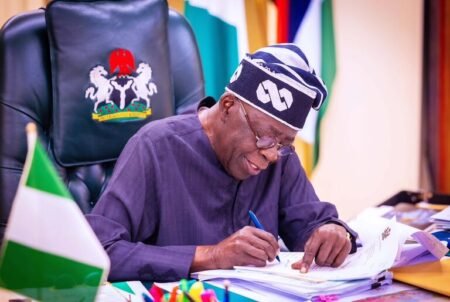



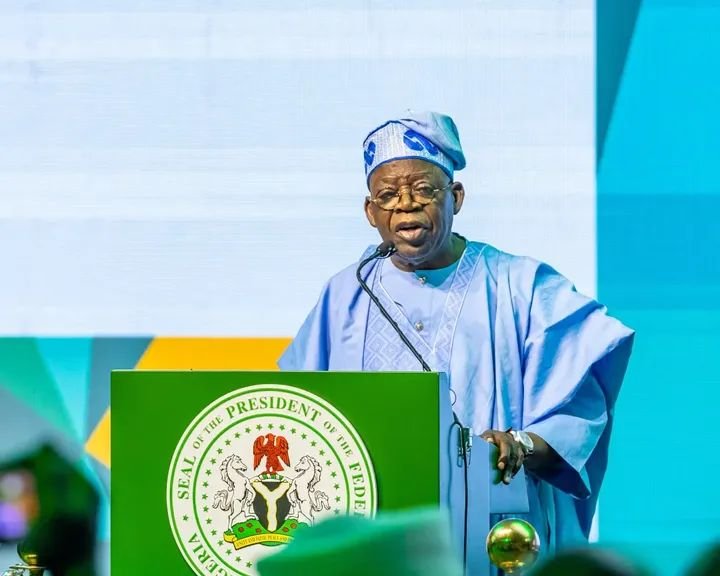
President Bola Tinubu has called on state governments to make sure that the savings gained from cheaper CNG-powered transportation result in reduced fares for Nigerians before October 1.
Tinubu issued this call in a Saturday statement that updated Nigerians on the National Affordable CNG Transit Programme, which came into being after his August 27 meeting with the 36 state governors.
He stated that the goal he and the governors agreed on was for more Nigerians to start seeing “measurable reductions in transportation costs” beginning October 1.
“I encourage every state to maintain the momentum towards October 1. Work with transport unions and commercial operators. Support conversion and fleet deployment.
“Facilitate the infrastructure required. Above all, ensure that savings from cheaper energy reach Nigerian citizens through lower fares,” he said.
The president stated that a number of states were already seeing lower transport fares thanks to CNG-powered and electric buses.
He pointed to Borno, where commuters pay between N50 and N100 for CNG-powered and electric public transport on routes where commercial operators charge between N300 and N600.
In Kaduna, he noted, 100 CNG-powered buses offered free rides on major routes, transporting roughly 3.2 million passengers in their first year and saving commuters over N3.5bn in transport costs.
Tinubu further said that CNG buses assigned to Pacesetter Transport in Oyo brought the Lagos-Ibadan fare down from about N8,000 to N3,200 during the initial rollout.
He said alternative-energy transit services in Adamawa lowered fares by up to 50 per cent, from N8,000 to N4,000, while 100 CNG buses in Enugu cut the Enugu-Nsukka fare from N2,500 to N1,500.
On the Plateau, he said, government-supported buses carry about 13,000 commuters each day at N200, against the more than N500 charged by commercial operators.
Tinubu also mentioned CNG-converted commercial vehicles running on several Abuja routes under a partnership with the National Union of Road Transport Workers, noting that passengers enjoyed a 40 per cent fare reduction.
By his account, fares from Area 1 to Gwagwalada dropped from N1,500 to N900, Nyanya from N700 to N420, and Wuse from N400 to N240.
He said passengers travelling the Suleja-Abuja route in Niger paid N550 instead of about N800, while Abia had rolled out 40 electric buses with fares subsidised by 50 per cent.
“These are not projections. Nigerians are already experiencing these savings,” Tinubu said.
The President stated that the Federal Government would back states in growing the program, pointing out that global energy supply disruptions were driving up petrol and diesel prices and raising transportation costs.
He said, “Through our partnership with the NURTW, passengers on CNG-converted commercial vehicles on several Abuja commuter routes receive a 40 per cent fare reduction.”
Tinubu noted that as a gas-rich nation, Nigeria could lessen its vulnerability to global energy price shocks by increasing the use of alternative energy for transportation.
He stated that over the past three years, more than 120,000 vehicles had been converted to CNG, and the country now boasts over 400 certified conversion centers and more than 90 CNG refueling stations.
He also drew attention to CNG progress in Edo, Kano, Delta, Kwara, Lagos, and Akwa Ibom.
Tinubu said Edo had 50 CNG buses in active operation, while Kano had converted over 1,000 commercial vehicles.
He added that Delta, Kwara, and Lagos were growing their CNG-supported transport services, while Akwa Ibom had received 50 CNG buses ahead of commercial operations.
The President said the Federal Government would keep supporting CNG infrastructure, conversion capacity, and the involvement of transport operators, manufacturers, and private investors.
“At a time like this, our answer cannot be to return to the ruinous petrol subsidy regime that consumed trillions of naira and left our economy exposed to every movement in international oil prices, as some have suggested.
“We must accelerate the cheaper alternatives we have been building at home,” he said.
Tinubu added, “Nigeria has the gas. We are building the infrastructure. We are already seeing the savings.
“Now we must move faster and scale this so more Nigerians feel those savings in the fares they pay every day.”