



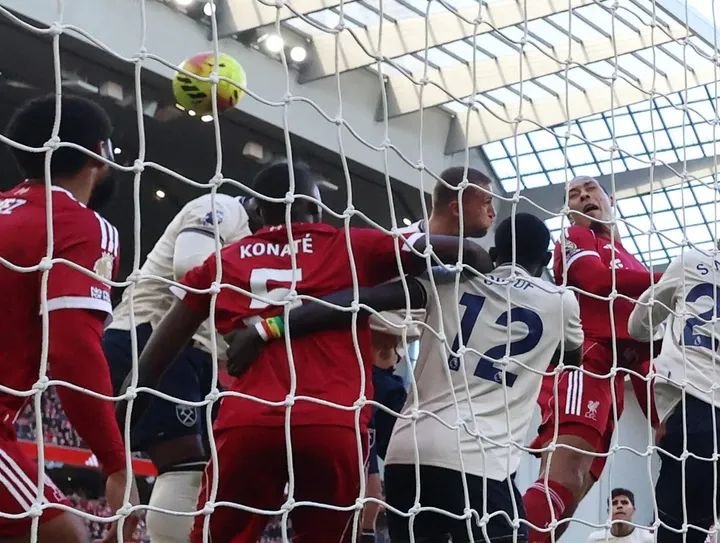
The Premier League will adopt a harsher stance on holding and grappling at set pieces this season, with officials told to pay more attention to actions that have a discernible influence on the game.
Although the game’s laws remain unchanged, officials from the Premier League, English Football League, and Women’s Super League have been instructed to take stronger action against deliberate holding, especially when it prevents opponents from competing for the ball or moving into dangerous positions.
The emphasis will be on what officials refer to as “non-footballing holding actions,” which occur when a player is solely focused on an opponent, does not attempt to play the ball, uses both arms to grasp an opponent, or consistently clutches a player or their clothing.
Defenders who turn their backs to an oncoming corner or free kick and purposefully hold an attacker to hinder movement may face a penalty under the new rules.
According to BBC Sport on Thursday, Premier League referees’ chief Howard Webb stated that officials had been pushed to act decisively rather than delivering warnings frequently.
“We’re trying to get the officials to be as confident as they can be to penalize what they see.
“So fewer warnings, more actions penalized, and if there’s any reduction in offences being penalized, it should be a result of a modification of player behavior rather than us no longer applying it,” Webb added.
The harsher approach comes after concerns about missed VAR interventions last season. Of the 20 missed interventions discovered, one-quarter involved penalties that were not awarded after players were pulled to the ground away from the ball.
However, Webb emphasized that the Premier League will not take an overly strict stance on physical contact, particularly amongst goalkeepers.
The league will maintain a high contact threshold, which means that ordinary bumps will not result in a goal being disallowed. However, a goalie whose movement is plainly restricted, such as having one arm held back, may still be penalized.
The adjustment may have a huge impact on set-piece tactics, as Premier League clubs scored 269 goals from set pieces last season, excluding penalties and direct free kicks. Such goals accounted for a league-high 25.7% of total goals.
Arsenal topped the way with 25 set-piece goals; Manchester United had 21, and Tottenham Hotspur had 19.
Liverpool conceded the most goals from set pieces in the league, with 19, followed by Chelsea and Newcastle United, both with 17.
Arsenal’s triumph was especially impressive because they blended attacking efficiency and defensive strength, conceding only seven set-piece goals.
The new refereeing emphasis may change how clubs defend and attack corners and free-kicks.
According to Webb, the goal is not to eliminate physicality from football but to discourage actions unrelated to the game.
“If we start penalizing offenses, players have to adjust their tactics,” he said. “And then those kinds of situations reduce in number,” he said.
The technique will now be evaluated throughout the season, with consistency expected to be critical.
Referees will need to maintain the level beyond the first several weeks while also ensuring that natural physical contact stays part of the game.
For players and teams, deliberate holding at set pieces will be scrutinized more closely, and those who continue to employ grappling as a tactic risk receiving penalties.