




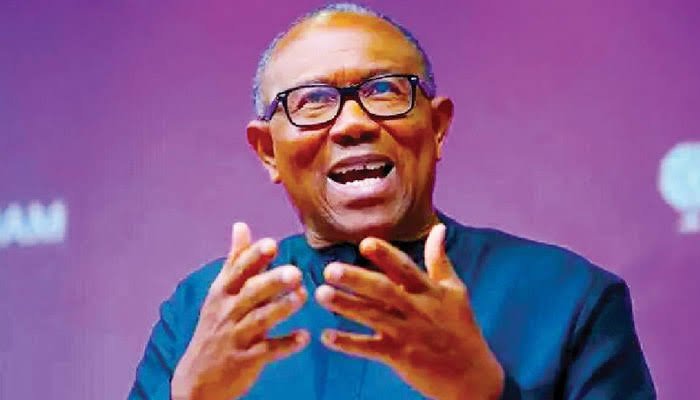
The Presidential candidate of the Nigeria Democratic Congress (NDC), Peter Obi, has sparked renewed debate on Africa’s development trajectory after addressing members of the European Parliament.
In the seven-minute address, Obi argued that Africa’s central challenge is not a shortage of natural resources but a deficit in leadership and governance.
He described the continent as richly endowed with mineral wealth, strategic economic value, and a young population, yet still struggling to convert these advantages into widespread prosperity.
Focusing on Nigeria, he referenced its estimated population of around 240 million people, positioning it as one of the world’s largest labour markets and consumer bases.
Obi stated that with stronger governance structures, Nigeria could become a significant driver of economic growth for both Africa and Europe, strengthening cooperation in trade, manufacturing, investment, and security.
He added that improved leadership and institutional reforms would also help reduce long-standing challenges, including insecurity, migration pressures, and economic instability.
According to him, sustained investment in accountable governance would unlock broader development outcomes across the continent.
The speech has generated mixed reactions across social media and political discussions.
Supporters described it as a reminder of the importance of leadership quality and institutional strength in shaping Africa’s future.
Critics, however, questioned the practicality of the ideas, arguing that rhetorical commitments must be matched with measurable outcomes.
Despite differing interpretations, the intervention has reignited wider discussions on governance, accountability, and Africa’s role in the global economy.
As political activity builds ahead of the 2027 elections, the remarks are expected to remain part of broader debates on Nigeria’s development direction.