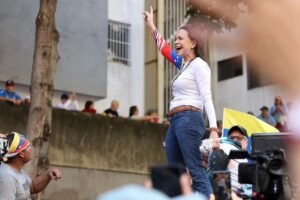



Maria Corina Machado has returned to Venezuela, with cheering supporters lining the roads from the western state of Lara all the way to the capital.
Vibrant, noisy, open, and defiant, it was a stark contrast to how the Venezuelan opposition leader had slipped out of the country in the dead of night last December to accept the Nobel Peace Prize in Oslo.
Until now, she had been unable to get back to her homeland, having been blocked on several occasions by the Venezuelan government and by the Trump administration, which maintained that the “time wasn’t right” for her return. Now, it seems, it is.
“Maria Corina is the indisputable leader of Venezuela,” says 20-year-old Gregory Noriega, wearing a sweatshirt emblazoned with the logo of the opposition movement Vente Venezuela. “Her return represents hope.”
“This is a step forward in the electoral process, which we’ve been waiting for since last year,” echoes 18-year-old Hilary, who turned out on to the streets of the capital hoping to catch a glimpse of the opposition leader on her victory lap.
“She’s returned after the double earthquakes when Venezuela needs her,” adds her friend, Manuel. “The whole country is behind her to show that now Venezuela isn’t scared.”
A great deal has changed since Machado departed Venezuelan territory to accept the Nobel Peace Prize.
Nicolás Maduro, who was president at the time, no longer sits at the head of Venezuela’s government.
On 3 January, US troops forcibly removed Maduro from power and hurried him to New York, where he faces charges of drugs, weapons, and torture all of which he has pleaded not guilty to.
His former vice-president, Delcy Rodríguez, took his place, and she has opened a new chapter with Washington in ways that few would have anticipated.
The relationship between the two countries today bears no resemblance to the years of mutual hostility under President Hugo Chávez and then his handpicked successor, Maduro.
These new circumstances present some intriguing dilemmas for both sides.
At the time Machado left Venezuela, she had for a long while been seen as Washington’s preferred alternative to Maduro. On her return, she finds the Trump administration entirely content with the leader it already has at least for now.
The Trump administration recently concluded a major oil agreement with Venezuela, granting the US a 100-year concession over an astonishing 65 billion barrels of Venezuelan crude oil.
The agreement was struck together with a Venezuelan private firm, North American Blue Energy Partners (NABEP), headed by a businessman with a questionable track record, Alejandro Betancourt.
Machado has publicly condemned the deal that the Rodríguez government reached with the US, though she is careful to aim her criticism at Caracas and at Betancourt rather than at President Trump, to whom she gave her peace prize and whose trust and backing she desperately needs in order to move forward.
President Trump has said on numerous occasions how pleased he is with Delcy Rodríguez, describing her as “wonderful” and “a terrific person.” This is the same vice-president of an administration he once characterized as consisting of “narco-communists.”
Yet the flood of celebration that greeted Machado’s caravan into the capital demonstrates that she can still rely on considerable support on the streets, according to Venezuelan political analyst Beningno Alarcon.
“The return of Maria Corina Machado, in my personal view, is the most significant [political] event since 3rd January,” says Alarcon. “It means the most important political leader in Venezuela is back in the country.”
“The reception for her return shows that her ability to mobilize her support remains intact, which means the opposition in Venezuela now has something very solid: a leadership that is present on the ground as opposed to solely in exile,” he says.
Alarcon offers some evidence that the opposition and the wider public have felt increasingly emboldened since 3 January, a situation he thinks will only grow more pronounced with Machado’s reappearance.
For example, a joint study by the political think tanks Polis and Nexo indicates that Venezuela experienced three times as many street protests in the first nine months of this year as in all of 2025, with demonstrations covering a range of issues, from politics and working conditions to water supply.
Moreover, there is evidence that the repression of such protests has fallen by more than half.
In an environment like this, the return of a figurehead such as Machado can energize an electorate that has spent years fearing the consequences of speaking out.
Her return should also be viewed in the context of the broader talks brokered by Washington between the Venezuelan government and the opposition aimed at a negotiated political solution.
Indeed, the US Secretary of State, Marco Rubio, was quick to state that her “safe return” to Venezuela was “the direct result of the US-supported reconciliation talks.”
The Nobel Peace Prize winner still faces charges in Venezuela that range from treason to conspiracy of insurrection. For years, she and her supporters have rejected the charges as politically motivated and without foundation.
After making at least eight attempts to return to Venezuela by air and by sea before the Trump administration gave her the green light, Machado now knows she has Trump’s blessing to be back on home soil a position Delcy Rodríguez is neither willing nor likely to challenge.
She described Machado’s return as a “show,” and the entire cross-country event, which her supporters livestreamed over the weekend, was deliberately ignored by state television outlets.
But Rodríguez, too, needs a harmonious relationship with Washington if she is to avoid a fate similar to her predecessor’s, and she has indicated she might be ready to hold talks with Machado.
Much as Trump has praised Rodríguez, he has also made it clear that Washington expects nothing short of her full submission and malleability on key issues such as energy.
Some reports have even suggested that all major decision-making in the oil-rich nation is largely being dictated by Secretary Rubio through regular WhatsApp calls to the interim president.
The young supporters who gathered in droves in Caracas to cheer Machado home say their fear of criticizing their government or demanding change is fading.
Her return marked an irreversible political transition in Venezuela, they insist, one they could barely have imagined when she left for Oslo just a year ago.