


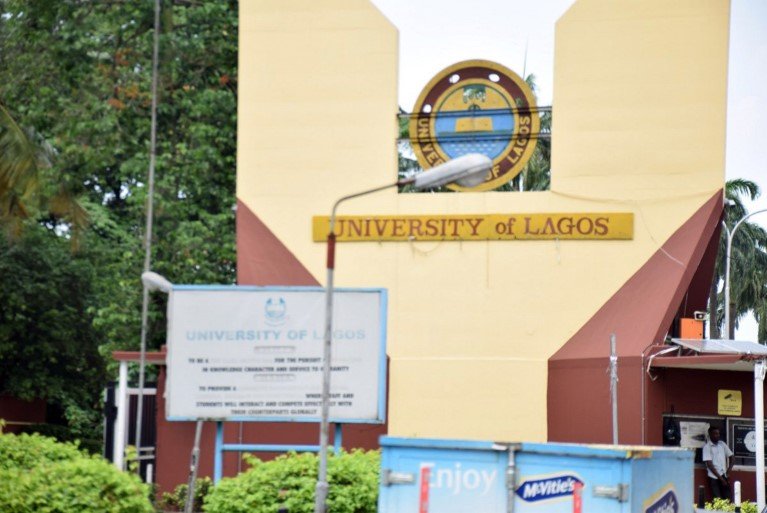
The University of Lagos (UNILAG) has emerged as “Nigeria’s highest-ranked institution in the 2027 QS World University Rankings: Sustainability, moving more than 700 places to secure joint 697th position globally.”
In the latest ranking released on Tuesday, November 17, 2026, the university moved up from the 1,401–1,500 band in the 2026 edition to the global top 700.
Prof. Peter Okebukola, Chairman of the Nigerian Tertiary Education Ranking Advisory Committee, made this known on Tuesday in Abuja while presenting the committee’s report to the Minister of Education, Dr. Tunji Alausa.
Okebukola stated that UNILAG’s improvement is the largest advance by any African university and one of the three biggest gains globally among the 1,819 institutions included in both the 2026 and 2027 editions.
He called the development a major achievement for Nigeria’s university system, pointing out that it showed local institutions can improve their global standing.
“A Nigerian public university, working under the same conditions as its peers, has shown in 12 months that rapid progress is possible.
“The belief that global standing is beyond the reach of Nigerian universities has been answered with evidence,” he said.
The committee said, “UNILAG improved its scores across all 11 performance measures assessed by QS, recording its biggest gains in environmental education, governance, and equality.”
In the latest ranking released on Tuesday, November 17, 2026, the university moved up from the 1,401–1,500 band in the 2026 edition to the global top 700.
Prof. Peter Okebukola, Chairman of the Nigerian Tertiary Education Ranking Advisory Committee, made this known on Tuesday in Abuja while presenting the committee’s report to the Minister of Education, Dr. Tunji Alausa.
Okebukola stated that UNILAG’s improvement is the largest gain by an African university and ranks among the three biggest advances worldwide out of the 1,819 institutions included in both the 2026 and 2027 editions.
He called the development a major achievement for Nigeria’s university system, pointing out that it showed local institutions can improve their global standing.
Other Nigerian institutions that appear in the ranking are Ahmadu Bello University, Zaria; the University of Nigeria, Nsukka; and Obafemi Awolowo University, Ile-Ife. Even though the three institutions stayed in the 1,501+ band, they posted better scores in a number of performance areas.
NiTERAC stated that the six Nigerian universities included in the ranking saw their average scores rise across every assessment measure.
It added that Nigeria now ranks above the global median in Knowledge Exchange and Employability and Opportunities and matches the global median in Environmental Education.
The improved performance has also lifted Nigeria from sixth to fourth among African countries, ranked by their highest-placed university. According to the committee, Nigeria is now home to the highest-ranked university in Sub-Saharan Africa outside South Africa.
In explaining what drove the improvement, Okebukola largely credited a stable academic calendar free of general strikes, better salaries for university staff, and increased funding for teaching and research facilities, especially through the Tertiary Education Trust Fund.
“These are achievements of government and the university community working together, and the results show that they are bearing fruit,” he said.
He called on the federal government and university authorities to keep up the improvements, stressing that industrial harmony, adequate funding, and better working conditions would matter in strengthening the country’s performance.
Notwithstanding the progress, NiTERAC raised concern that only six Nigerian universities appeared in the ranking, out of more than 300 institutions in the country’s tertiary education system.
It also observed that Covenant University, Nigeria’s highest-ranked institution in the 2026 edition, slipped to the 1,151–1,200 band in the latest ranking.
The committee named Governance, Environmental Research, Equality, Environmental Sustainability, and Health and Wellbeing as areas where Nigerian universities still have significant gaps to close.
It said many of these shortcomings stemmed from institutional policies, documentation, and public disclosure rather than funding, and added that universities could make improvements within one or two ranking cycles.
NiTERAC therefore urged universities to develop and publish sustainability policies approved by their governing councils, make audited financial statements and governance documents available online, and establish policies on equality, inclusion, health and wellbeing.
It also recommended that universities set up research clusters focused on climate change, energy, water, and food security, and appoint sustainability officers to coordinate their submissions to international ranking organizations.
For the Federal Government, the committee proposed a national sustainability policy framework for tertiary institutions and a dedicated TETFund intervention for green campus infrastructure and sustainability research.
It further recommended that the National Universities Commission build sustainability and transparency indicators into its accreditation process.
As part of efforts to raise Nigeria’s standing, NiTERAC said it would hold a peer-learning forum at which the University of Lagos would share its experience with other institutions.
The committee also proposed annual capacity-building sessions for directors of academic planning and ranking officers through the Virtual Institute for Capacity Building in Higher Education.
It further recommended that Nigeria aim for at least 10 universities in the 2028 sustainability ranking, with three of them among the world’s top 1,000.
It proposed that by the 2030 and 2031 editions, at least 20 Nigerian universities should be included, with eight of them among the top 1,000 and the country’s highest-ranked institution among the world’s top 400.
Congratulating UNILAG, the University of Ibadan and Covenant University, Okebukola said that improving global rankings should go hand in hand with raising the quality of university education.
“Improving in this ranking and improving the quality of our university system are the same task.
“If universities, government, and the ranking community each play their part, the story of the University of Lagos in 2027 will become the story of many Nigerian universities by the end of the decade,” he said.
The QS World University Rankings: Sustainability assesses universities based on their environmental and social impact, along with their governance.
It examines how institutions help tackle global sustainability challenges through their research, teaching, campus operations, and engagement with society.
The ranking offers a way to gauge universities’ contributions to sustainable development beyond traditional academic metrics like research output and academic reputation.