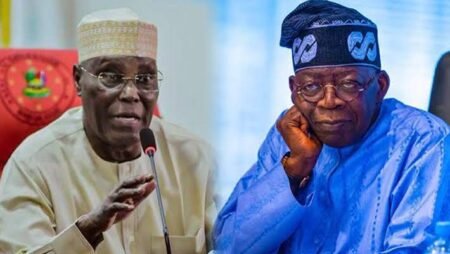





President Bola Tinubu has joined the United States Department of Justice’s request for additional time to respond to a court order concerning the release of records linked to allegations of drug trafficking against him.
Christopher Carmichael, one of Tinubu’s lawyers, filed a notice of joinder at the US District Court on behalf of the Nigerian president, supporting the government’s request for a 10-day extension.
“Intervenor joins Defendants’ motion for a 10-day extension of time to file response to the motion for summary judgment (DE 92), in as much as Intervenor requests that the responses remain on the same schedule,” the notice said.
The filing noted that the plaintiff opposed the request, while the defendants did not.
The development was publicised by Von Batten-Montague-York L.C., a Washington-based lobbying firm recently hired by former Vice-President Atiku Abubakar.
The lobbying firm subsequently claimed that the judge “swiftly” denied Tinubu’s request.
It also alleged that Tinubu could use any delay to lobby US officials over the potential release of the records, claiming that disclosure could affect US-Nigeria relations.
The firm said: “We surmise that President #Tinubu wants to use any delay to call upon his friends in DC to argue that the release of these files would harm U.S.-Nigeria relations and undermine his ability to work with the United States to combat terrorism and the killing of Christians in Northern Nigeria.”
It further said US government personnel who improperly attempted to interfere with the judicial or Freedom of Information Act (FOIA) process should be “exposed and fired”.
US government seeks more time
Before Tinubu’s notice of joinder was published, the lobbying firm reported that Jeanine Pirro, a US attorney, had initiated court action to comply with an order directing the Federal Bureau of Investigation (FBI) and Drug Enforcement Administration (DEA) to release records concerning their investigations into the allegations.
According to the firm, Pirro requested an additional 10 days. However, Judge Beryl Howell granted only four additional days, moving the deadline to August 21.
The lobbying group said Howell noted that the case had already been pending for more than three years.
How the case began
The case dates back to 2022 and 2023, when Aaron Greenspan, an American and founder of PlainSite, submitted 12 FOIA requests to six US federal agencies.
The requests sought information from criminal investigations into a Chicago heroin ring that operated in the early 1990s.
Greenspan sought investigative records concerning four individuals allegedly associated with the drug ring: Tinubu, Lee Andrew Edwards, Mueez Abegboyega Akande and Abiodun Agbele.
Five agencies issued so-called Glomar responses, saying they could neither confirm nor deny the existence of the requested records.
After the US Department of Justice’s Office of Information Policy upheld the agencies’ responses, Greenspan filed a lawsuit on June 12, 2023.
The FBI, DEA, Internal Revenue Service, Executive Office for United States Attorneys and Department of State were initially named as defendants. The CIA was later added in an amended complaint.
In April 2025, Howell ruled that the Glomar responses issued by the FBI and DEA were “improper and must be lifted”.
The judge held that the agencies had failed to establish a cognisable privacy interest in keeping secret the fact that Tinubu had allegedly been a subject of a criminal investigation.
Tinubu’s 1993 US forfeiture case
The allegations date back to a 1993 US case in which Tinubu forfeited $460,000 to the US government in proceedings linked to alleged heroin trafficking.
The issue became prominent during litigation arising from Nigeria’s 2023 presidential election.
Peter Obi, the former Labour Party presidential candidate, and Atiku Abubakar argued before the Presidential Election Petition Court that Tinubu should have been disqualified over the US forfeiture.
However, the PEPC held that the petitioners failed to establish that Tinubu had been convicted of a criminal offence in the United States.
The court also ruled that the forfeiture proceedings were civil in nature.