




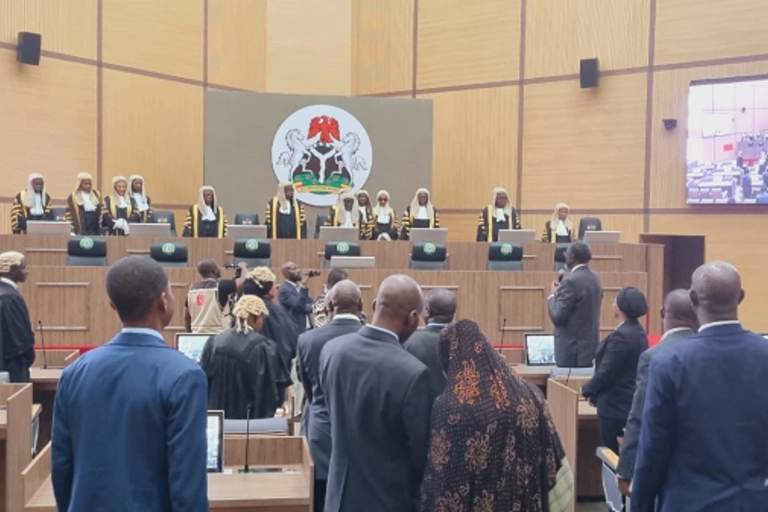
Nigeria’s opposition landscape faces a decisive moment today as the Supreme Court of Nigeria hears critical appeals that could redefine the fortunes of both the Peoples Democratic Party and the African Democratic Congress ahead of the 2027 elections.
The appeals, filed by factions within both parties, challenge earlier rulings by the Court of Appeal in Abuja and centre on leadership disputes that have weakened internal cohesion.
At the heart of the ADC crisis is a leadership tussle involving former Senate President David Mark and rival claimant Nafiu Bala, a development that has already prompted the Independent National Electoral Commission to withdraw recognition of the party’s leadership.
ADC pushes ahead with convention amid venue row
Despite the uncertainty, the ADC has resolved to proceed with its 2026 National Convention in Abuja, expected to host about 3,000 delegates.
The party accused authorities in the Federal Capital Territory Administration of blocking access to traditional venues, including Eagle Square and the Moshood Abiola National Stadium Velodrome.
According to spokesperson Bolaji Abdullahi, the convention will now hold at the Rainbow Events Centre regardless of the setbacks.
He described the situation as a threat to democratic practice, arguing that public facilities should not be restricted based on party affiliation.
Deepening internal crisis in Adamawa
The crisis has further escalated in Adamawa State, a political stronghold of Atiku Abubakar, where a faction announced the suspension of key figures, including Atiku and former SGF Babachir Lawal.
However, party leaders dismissed the move as illegitimate, exposing the depth of divisions within the ADC.
The dispute is already before the court, with the Adamawa State High Court halting congresses pending further hearing.
PDP also awaits crucial verdict
The PDP is similarly entangled in legal battles, with appeals filed by a faction led by Kabiru Turaki challenging appellate court decisions involving party leadership.
The outcome of these cases is expected to provide clarity on control of party structures ahead of the next election cycle.
Implications for 2027 elections
Today’s rulings could significantly influence opposition readiness for 2027, particularly as concerns grow over the weakening of multi-party competition.
While critics warn of a drift towards one-party dominance, presidential aide Sunday Dare has rejected such claims, insisting Nigeria’s political space remains open.
He maintained that multiple parties are still active and attributed opposition struggles to internal crises rather than government interference.
High stakes for opposition unity
With preparations intensifying for the 2027 general election, the Supreme Court’s decisions may determine whether opposition parties can resolve their disputes in time to mount a credible challenge or remain fragmented.