


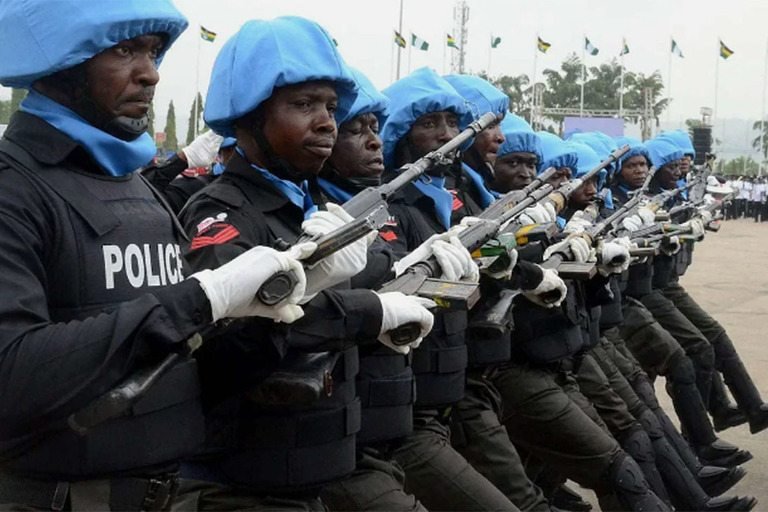
The Borno State Police Command has raised an alarm over information making the rounds on social media about a purported protest in the state.
ASP Nahum Daso, the command’s spokesperson, promised in a brief statement issued early on Friday that the command is still watchful and has taken the required steps to guarantee everyone’s safety and security.
However, the statement pointed out that there hasn’t been a verified report of any planned protests yet.
It reads, “The Borno State Police Command is aware of information circulating on various social media platforms regarding a purported protest.
“At the moment, there is no confirmed report of any planned protest in the state,” he noted.
The PPRO, however, assured that the force has put necessary measures in place to ensure the safety of residents.
“However, the Command remains vigilant and has put in place necessary measures to ensure the safety and security of all residents,” he stated.
Daso advised the public to ignore unreliable information, carry out their legal obligations, and uphold the law.
The police did not, however, provide the rationale behind the alleged demonstration.
The Acting Inspector General of Police (IGP), Olatunji Disu, has ordered state police commissioners to be on red alert to prevent worsening internal security challenges in the country following the United States’ and Israel’s war on Iran.
The Nigeria Police spokesperson, Benjamin Hundeyin, issued a statement yesterday in Abuja that included the IGP’s directive.
Members of the Islamic Movement in Nigeria (IMN) protested the death of Iran’s Supreme Leader, Ayatollah Ali Khamenei, in the US-Israeli strike, which prompted the acting IGP to issue the command.
Members of the Islamic Movement in Nigeria (IMN), popularly known as Shiites, led by Ibrahim El-Zakzaky, had protested in Lagos, Gombe, Niger, Kano, Bauchi, Yobe, and Sokoto states over the killing of Iranian Supreme Leader Ayatollah Ali Khamenei in a joint US-Israeli airstrike.
Hundeyin claims that Disu specifically instructed police commissioners in the Northwest, Northeast, and North Central zones to improve visible policing around places of worship and public areas, increase surveillance and intelligence gathering, and strengthen cooperation with traditional and religious leaders.