

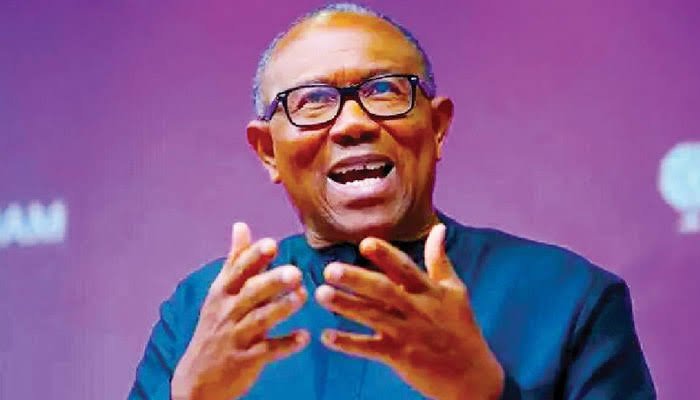
Peter Obi, the presidential candidate of the Nigeria Democratic Congress, has maintained that throughout his eight years as governor, he never borrowed money or issued bonds on behalf of Anambra State.
Speaking on Arise TV’s Prime Time program on Thursday, Obi stated that when his administration left office in March 2014, it owed nothing in salaries, gratuities, pensions, or payments to contractors whose jobs had been completed, certified, and verified.
The former governor was reacting to questions about recent claims by the Anambra State Government that his administration left behind unpaid debts and other liabilities for later governments to settle.
“Let me categorically state again: I, Mr. Peter Obi, did not approach any financial institution to borrow money or issue bonds on behalf of Anambra State in the eight years I was in government.
“On the day I left office, the government of Anambra State, which I headed, was not owing any salary, gratuity, or pension to those scheduled to be paid by the state government.
“We were not owing any contractor or supplier who executed his job, certified, and verified—not one,” he said.
Obi stated that the loans being attributed to his administration were not funds he personally obtained from financial institutions, arguing that some of the funding arrangements were supported by the federal government.
“I didn’t go to obtain it. But what I’m saying, assuming that your father left you with an inheritance of N100m, is that suddenly somebody comes up and says your father owes N10m. Are you going to go to the market and say your father left you with debts? Unless there’s another thing, you’ll be unfair,” he said.
He argued that the federal government had selected Anambra, Ekiti, and Bauchi states to receive concessionary multilateral support because of their performance in education.
“There’s a difference between me going to the bank to borrow money, and then the Federal Government seeing, ‘Oh, this state is doing well in education.'” They selected Anambra, Ekiti, and Bauchi and said, ‘These three states are doing well. Why don’t we give them a concessionary multilateral support to help them?’”
Obi mentioned that the funding, which involved the World Bank, was not obtained by Anambra from a commercial bank.
“Yes, and the World Bank,” Obi said, when the interviewer asked whether the funding was a decision by the Federal Government to provide support.
“To support us. Not that we go to the World Bank and say, “Give me this,” but not that we go to any commercial bank. And to even make it more… when it came, if you look at the State Education Programme Investment Project (SEPIP), you will see that the drawdown was well after I left office.”
The former Anambra governor added that even if the entire amount in question had been drawn down, there would have been sufficient funds left to cover it.
“I’ve assumed the whole and said even if that was the case, there was enough left to pay it, and the state will still be at the best financial standing,” he said.
Obi further argued that undrawn funds under a loan facility should not be regarded as debt incurred by the government.
“Even if I had gone to a bank and borrowed money—even if I had gone to a bank and borrowed money, but I did not spend the money—you cannot call it debt I left.
“Assuming I have gone to the bank and said, ‘Bank A, borrow me a loan; give me a loan of N10 billion. And they gave me a loan of 10 billion Naira, and I only drew down 500 million; you cannot now say I’m owing 10 billion because you know the amount. That’s why I said it is not proper public sector accounting.”
To buttress his position, Obi cited former Debt Management Office Director-General Abraham Nwankwo, whom he said served for 10 years.
He mentioned that Nwankwo had invited him to chair his send-off ceremony and publicly stated that Obi was the only governor in Nigeria who never visited his office to seek approval to borrow money.
“To even confirm this: the then DG… Abraham Nwankwo, who was DG of the Debt Management Office, served for 10 years.
“The day he left office, at his send-off party, he invited me as the chairman, and he announced to everybody at that party that the reason why he made me chairman is that I was the only governor in Nigeria who never came to his office for approval to borrow money,” he said.
This dispute came after recent criticism from the Anambra State Government, which claims that Obi left behind unpaid external loans and other liabilities.
Not long ago, the state government dared Obi to withdraw from the 2027 presidential race, claiming he left behind unpaid external loans as well as salary, pension, and gratuity arrears, and that he broke earlier promises regarding debt and paying workers on time.
Via its New Media Office and the Commissioner for Information and Value Reorientation, Dr. Law Mefor, the state claimed that eight external borrowings taken during Obi’s time in office left an outstanding balance of roughly N127.4 billion (from $123.77 million) as of June 30, 2026, which is still being repaid from federal allocations.
It also pointed to salary arrears, including those at the Water Corporation, and challenged Obi’s assertion that he left more than N2.13 billion in an ecological fund account. ↻
Obi had earlier promised to halt his campaign if it were proven that he left the state in debt or with unpaid obligations to certified contractors.