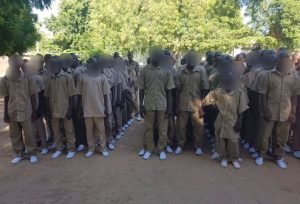



The US has placed Nigeria on its Child Soldiers Prevention Act blacklist, saying the designation could lead to cuts in military training, weapons sales, foreign military financing, and defense cooperation from October 1, 2026, unless President Donald Trump issues a waiver.
This came after the US Department’s 2026 Trafficking in Persons Report cited the continued recruitment and use of children by Boko Haram and ISIS-West Africa on Nigerian soil.
The report, published on October 11, covers April 1, 2025, to March 31, 2026, and is the latest available assessment of Nigeria’s anti-trafficking performance by the US State Department.
It placed Nigeria on a list of 14 nations, including Russia, Iran, South Sudan, and Somalia, that are accused of recruiting or using child soldiers.
The report also disclosed that the country’s anti-trafficking performance failed to meet minimum standards for the 15th consecutive year.
“Governments identified on the list are subject to restrictions, in the following fiscal year, on certain security assistance and commercial licensing of military equipment.
“The CSPA prohibits assistance to governments that are identified in the list under the following authorities: International Military Education and Training, Foreign Military Financing, Excess Defense Articles, and Peacekeeping Operations, with exceptions for some programs undertaken pursuant to the Peacekeeping Operations authority.
“The CSPA also prohibits the issuance of licenses for direct commercial sales of military equipment to such governments. Beginning October 1, 2026, and effective throughout Fiscal Year 2026, these restrictions will apply to the listed countries, absent a presidential waiver, applicable exception, or reinstatement of assistance pursuant to the terms of the CSPA,” the report read.
It stated that the determination to include a government in the CSPA list is “informed by a range of sources, including first-hand observation by U.S. government personnel and research and credible reporting from various UN entities, international organizations, local and international NGOs, and international and domestic media outlets.”
This blacklisting occurs against the backdrop of an ongoing security partnership between the US and Nigeria, following the Trump administration’s deployment of Navy SEAL Team 6 alongside Nigerian forces for joint counterterrorism missions in the northeast and the formalization of the bilateral 2026 Defense Cooperation Roadmap.
The report notes that despite acknowledged corruption, no government official was prosecuted for state complicity in trafficking, even as the number of trafficking victims receiving government assistance plummeted from 2,058 the year before to only 675.
The document stated that the CSPA listing, unless waived by a sitting US president, could limit International Military Education and Training, Foreign Military Financing, Excess Defence Articles, peacekeeping assistance, and licences for direct commercial sales of military equipment to Nigeria.
It stated, “The government did not report any investigations, prosecutions, or convictions of government employees allegedly complicit in trafficking crimes or provide details or other actions taken against complicit officials from previous years,” adding that “corruption and official complicity in trafficking crimes remained significant concerns.”
The report further noted that “observers reported some law enforcement, military, and other government officials reportedly committed trafficking crimes, accepted bribes to facilitate trafficking, or obstructed justice by interfering with investigations.”
Regarding law enforcement, it stated that Nigerian authorities looked into 1,341 trafficking cases, made up of 589 sex trafficking cases, 301 forced labor cases, and 451 unspecified cases, involving 1,367 suspects. Out of these, 94 were prosecuted, and 97 traffickers were convicted.
The US recognized that “the majority of those convicted received prison sentences of at least one year” and that “officials increased collaboration with foreign governments on international trafficking investigations,” which led to operations across West Africa and Southeast Asia in partnership with INTERPOL.
Terrorists abduct CRIN workers in Oyo, demand N120m ransom
Terrorists kidnap 47 women farming in Niger
It stated that while 2,004 people were identified as trafficking victims, including 893 sex trafficking victims and 1,111 forced labor victims, only 675 received government-supported assistance that year, compared with 2,058 in the previous period.
The report condemned shelter conditions at the National Agency for the Prohibition of Trafficking in Persons, pointing out that NAPTIP’s closed-shelter policy meant “residents were not allowed freedom of movement, including children’s access to school,” and that “access to some protection services was tied to victims’ willingness to cooperate with law enforcement proceedings.”
It observed that adult victims who turned down shelter were not offered alternative services and that “only one dedicated NGO shelter was available for adult male trafficking survivors.”
Regarding the Child Soldiers Prevention Act listing, the report named Boko Haram and ISIS-West Africa as the entities responsible for recruiting children.
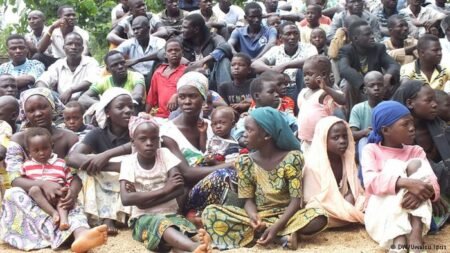
“Boko Haram and ISIS-West Africa continue recruiting, abducting, and using including through force, fraud, and coercion child soldiers as young as 12 years old as cooks, domestic workers, spies, porters, messengers, bodyguards or guards at checkpoints, “morality police,” armed combatants, and suicide bombers in attacks in Nigeria, Cameroon, Chad, and Niger; these children are subjected to physical and sexual abuse and forced drug use.
“These non-state armed groups continue to abduct women and girls in the northern regions of Nigeria, many of whom they exploit in forced labor, including in domestic servitude, and in sexual slavery. Boko Haram has kidnapped and subjected thousands of women and girls to forced marriage, including for sexual slavery and forced labor; Boko Haram punishes girls, including for refusing to marry, by forcing them to be suicide bombers.
“In many cases, the government coerces victims of forced marriage, including trafficking victims, to return to their Boko Haram husbands in Borno State demobilization centers. Criminal gangs in the south recruit and use children in forced criminality, including kidnappings and robberies, and exploit them in sex trafficking. Criminal gangs in the northwest also exploit victims in forced labor in agriculture and mining,” the report stated.
It stated that under US law, the CSPA listing could impose restrictions on International Military Education and Training, Foreign Military Financing, Excess Defense Articles, peacekeeping assistance, and licenses for direct commercial sales of military equipment, with these restrictions taking effect from October 1, unless a presidential waiver applies.
On labor trafficking, the report said the government “did not prohibit worker-paid recruitment fees…did not report holding labor recruiters liable civilly and criminally for fraudulent recruitment,” and “did not provide specialized training on child labor and human trafficking to labor inspectors.”
It also stated that “the government did not provide anti-trafficking training to its diplomatic personnel.”
The report further mentioned international criminal networks that treat Nigeria as their territory, stating that “highly organized foreign criminal syndicates fraudulently recruit foreigners to Nigeria with promises of employment, confine them in leased properties, and compel them to participate in organized online scams.”
The TIP report additionally claimed that “Russian authorities fraudulently recruit and use Nigerians to fight in the Russia-Ukraine war” and that Nigeria’s Ministry of Education “helped promote” Russia’s Alabuga Start program “despite warning signs.”
It raised concern that “North Korean nationals working in Nigeria may be operating under exploitative conditions, displaying indicators of forced labor.”
Regarding baby factories, criminal operations masquerading as orphanages, maternity homes, or religious centers where women are detained against their will, raped, and forced to give birth to children who are then sold, the report characterized these activities as a documented part of Nigeria’s trafficking landscape, found mainly in the south.
Even with these concerns, the US government recognized Nigeria’s higher allocations, such as funding for victim services, which climbed from N128m to N233m, while prevention spending rose sharply from N58.8m to N245m.
It further observed that the government arranged the return of 428 Nigerians who had been exploited overseas, obtained restitution for 14 victims through criminal sentences, and kept anti-trafficking task forces running in 23 states.
Nigeria, which serves as a source, transit, and destination country for trafficking, last earned the top Tier 1 ranking in 2011.
Across the annual report’s 25-year history, its status has shifted among Tier 1, Tier 2, and the lower Tier 2 Watch List.
The 2026 CSPA listing covers Afghanistan, Myanmar, the Democratic Republic of Congo, Ethiopia, Iran, Russia, Somalia, South Sudan, Sudan, Venezuela, Yemen, and two additional countries in a group the US regards as the most serious offenders in child soldier recruitment worldwide.
When reached for comment, Vincent Adekoye, NAPTIP’s Head of Press and Public Relations, stated that the agency would publicly release its response to the report.