




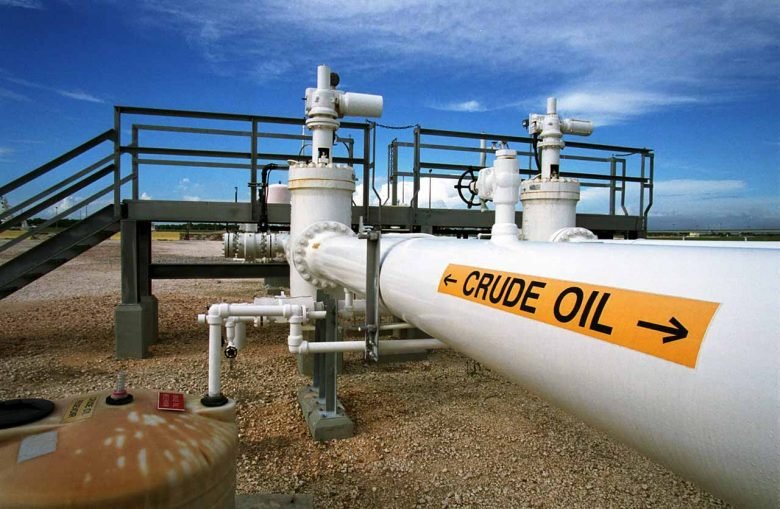
Nigeria exported 182.2 million barrels of crude oil worth N24.02 trillion in the first half of 2026 as rising worldwide oil prices increased the value of the country’s crude cargoes amid concerns about insufficient feedstock for domestic refineries.
Crude oil production and export data from January to June 2026 revealed that exported crude was worth around $17.60 billion, or N24.02 trillion, at an exchange rate of N1,365 to the US dollar.
According to data from the Central Bank of Nigeria, the country produced around 263.65 million barrels of petroleum over a six-month period, with a market value of $25.41 billion, or N34.69 trillion.
The estimations were based on average daily crude oil production and export volumes for each month, multiplied by the number of days in those months, and valued using the corresponding average monthly Bonny Light crude oil prices. June production and export levels were projected based on daily averages of 1.56 million barrels and 1.11 million barrels at an average crude price of $88.24 per barrel.
A month-by-month breakdown revealed that Nigeria produced 45.26 million barrels in January before dropping to 36.68 million barrels in February. Production grew to 42.78 million barrels in March, 44.70 million barrels in April, and 47.43 million barrels in May, with June production predicted at 46.80 million barrels.
Crude exports had a similar pattern. The country exported 31.31 million barrels in January, 24.08 million barrels in February, 28.83 million barrels in March, 31.20 million barrels in April, 33.48 million barrels in May, and 33.30 million barrels in June.
The value of crude produced during the time was predicted to be $3.08 billion in January, $2.65 billion in February, $4.54 billion in March, $5.67 billion in April, $5.34 billion in May, and $4.13 billion in June, for a total output value of around $25.41 billion.
Export earnings were predicted at $2.13 billion in January, $1.74 billion in February, $3.06 billion in March, $3.95 billion in April, $3.77 billion in May, and $2.94 billion in June, for a total of approximately $17.60 billion.
The crude was sold by both international and indigenous oil companies, including Nigeria’s National Petroleum Company Limited, demonstrating the country’s persistent reliance on crude exports as its primary source of foreign income.
The results also revealed that average daily crude production increased following a decline in February. Production increased from 1.46 million barrels per day in January to 1.56 million barrels per day in June, after falling to 1.31 million barrels per day in February.
Average daily crude exports also grew during the period, going from 1.01 million barrels per day in January to 1.11 million barrels per day in June; however, exports fell to 860,000 barrels in February.
Overall, Nigeria exported around 69% of its crude production in the first half of the year, leaving approximately 81.45 million barrels left for domestic refining, storage, operational usage, and inventory adjustments.
The increase in export earnings was mostly driven by higher international crude prices rather than increased export quantities. Between March and May, oil prices rose due to geopolitical concerns in the Middle East and disruptions in shipping via the Strait of Hormuz.
Although prices fell in June, they remained higher than at the start of the year, boosting the entire value of Nigeria’s crude exports.
The estimated values represent the gross market value of crude oil produced and exported but do not include the actual revenue received by the government, which is influenced by production-sharing contracts, royalties, taxes, operating costs, domestic crude supply obligations, and other commercial arrangements.
The export performance comes as domestic refineries continue to face concerns about crude supplies.
Stakeholders have often stated that despite the domestic oil supply obligation outlined in the Petroleum Industry Act, oil producers continue to choose exporting due to higher returns.
Dangote Petroleum Refinery has recently accused the federal government and its agencies of undermining domestic refining by failing to assure adequate crude supply, claiming that inadequate implementation of the Domestic Crude Supply Obligation has hampered its operations.
The refinery also temporarily banned the sale of petrol in naira, requiring marketers to pay in dollars until returning to naira sales.
In lawsuit documents filed before the Federal High lawsuit in Lagos, the refinery stated that its operations are dependent on crude supply agreements with the NNPC and maintained that insufficient domestic oil allocation was harming its refining business. The federal government has refuted the claims.
The Publicity Secretary of the Crude Oil Refinery Owners Association of Nigeria, Eche Idoko, said most modular refineries obtain crude directly from private oil producers rather than through government allocations.
He urged the federal government to rigorously implement the DCSO to ensure adequate feedstock for local refineries while maintaining Nigeria’s crude output and export ambitions.