




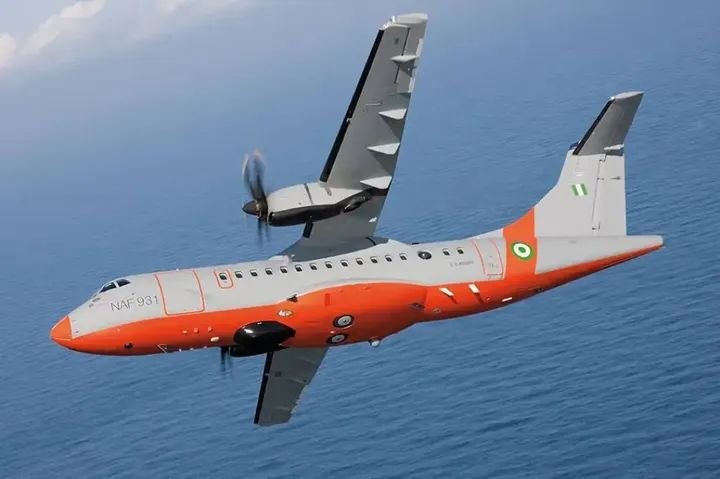
The pilot of the ill-fated NAF aircraft, which crashed in Igbokoda, Ondo State, has been described as a hero who saved the lives of the locals from being affected by the crash.
At first, the residents did not see the aircraft, tail number NGR 931, which was carrying 32 people, 25 passengers, and seven crew members on a routine flight from Benin to Lagos. They heard it instead.
“It sounded like the engine was coughing blood,” one fisherman told me at the edge of the swamp. “We looked up and saw it wobbling. It was coming down on our heads.”
According to residents, the aircraft was already in difficulty well before it went down.
They all agreed that if the pilot had not fought to keep it under control, Igbokoda could have been counting hundreds of fatalities.
“Honestly, the pilot should be commended,” said Jomiloju, a resident. “Many lives would have been lost. It would have been a national tragedy if he had allowed the aircraft to go down in the middle of the community. He struggled with it and brought it down inside a deep swamp, 200 meters away from the town.”
Another resident corroborated the account, saying, “If the captain had attempted to bring it down inside the town, it would have caused a bigger disaster. He eventually went into the river and crashed over there.”
In Igbokoda, the pilot is now seen as far more than just a victim. People consider him a hero.
“He is a big hero because he averted a tragedy,” another resident said. “The aircraft was heading towards the community, but he maneuvered it into the swamp. He should be celebrated in death for saving us from catastrophe. Although we are not happy, 32 persons died. They are family members who paid the ultimate price.”
Governor Lucky Aiyedatiwa gave a similar account when he went to the scene of the crash, backing up what the residents had said.
The governor stated that eyewitnesses informed him the aircraft descended with a loud noise that pointed to an engine failure, and it seemed to be moving in the direction of the town.
“But the pilot managed to maneuver the aircraft away from the community before it landed about 200 meters away and went straight into the swamp,” Aiyedatiwa said. “Only the pilot, if he had survived, could have explained what happened in those final moments.”
What came next was a scene. The governor called it “a very gory sight.”
Upon his arrival at the swamp, body parts, military jackets, clothing, and pieces of the aircraft were drifting on water darkened by aviation fuel. The main fuselage could not be located anywhere.
“The aircraft has sunk deep. The nature and depth of the swamp could have caused it to become deeply submerged in the mud,” he said.
To get to the wreckage, the state brought in two amphibious excavators, called swamp buggies, machines built to float and dig simultaneously. Even with that deployment, the main wreckage had still not been recovered seven days after the crash.
Navy divers, along with members of local communities, had been combing the swamp, recovering only pieces of the aircraft.
“I saw the divers struggling to locate the main fuselage,” said the Commissioner for Environment, Dr. Tob Loko.
“One of them said he was able to spot it, but the small boats were insufficient to pull it out. That is why we had to deploy heavier equipment.”
The Commissioner for Works, Ayorinde Olawoye, voiced confidence that advancement would be achieved before long.
“You can see the swamp buggy is set to float on water and go to where it happened. Within five hours, reasonable progress will be made,” he said.
Nevertheless, the Commissioner for Health, Dr. Banji Ajaka, described a far more dire situation.
“It is not something a vehicle or speedboat can just go to. It has gone down with weight and force,” he said.
At the location, the Ondo State Commissioner of Police, Felix Ohagwu, who reached the scene by canoe, stated that no one had survived.
“From what we have seen, there are no survivors. What we see is just body parts and clothes littered everywhere, floating in the water,” he said. “It is a very difficult terrain, the creeks, mangroves. Accessing the site was not easy.”
Members of the press were at first refused entry to the site. A television crew was said to have been detained by Navy personnel for gaining entry without permission, though they were released afterward.
“I was just trying to have my bath when I heard a loud noise. It was very frightening,” Jomiloju recounted. “We rushed towards the direction the sound came from. We had to sail to the location in canoes. All we saw was wreckage. The larger part of the plane was deep inside the swamp.”
Another resident, Lucky, added, “We have tried our best to rescue them, but the aircraft was deeply buried inside the swamp. Even the women and men took their canoes.”
A week after the crash, crucial answers were still stuck in the swamp alongside the wreckage.
The Nigerian Air Force verified that the flight data recorder, often called the black box, along with the cockpit voice recorder, had not yet been retrieved.
“We hope to be able to find critical components of the aircraft that will speak to the investigators because the aircraft wreckage actually speaks to the investigators.”
Air Vice Marshal Ebimobo Ebiowe, the NAF Superintendent of Standards and Evaluation, made the statement at the scene.
The Chief of the Air Staff, Air Marshal Sunday Kelvin Aneke, who toured Igbokoda and examined the site, directed a high-level probe that would include military and civilian aviation safety specialists, the Nigerian Safety Investigation Bureau, and retired senior officers.
“I have flown on this airplane. My family has flown on this airplane. I know each of the crew personally. They are highly trained, professional, and intelligent officers. The best we can do is to honor the sacrifice they have made,” Aneke said, appealing to Nigerians to avoid speculation.
Aiyedatiwa called the incident a national tragedy, offering his condolences to President Bola Tinubu, the Nigerian Air Force, and the families of the personnel who lost their lives in active service.
By Saturday, the Navy had brought in side-scan sonar equipment to chart the swamp and find the sunken fuselage. Aviation fuel was also said to be spilling into the water, sparking worries about pollution.
In Igbokoda, two tragedies are being mourned: the 32 lives claimed by the swamp and the possibly larger tragedy that residents believe was prevented by a pilot who, in his last moments, guided the aircraft away from the town.
Every time it drizzles on a Monday morning, they will recall the day the sky screamed and a man, as they see it, decided where he would die.