




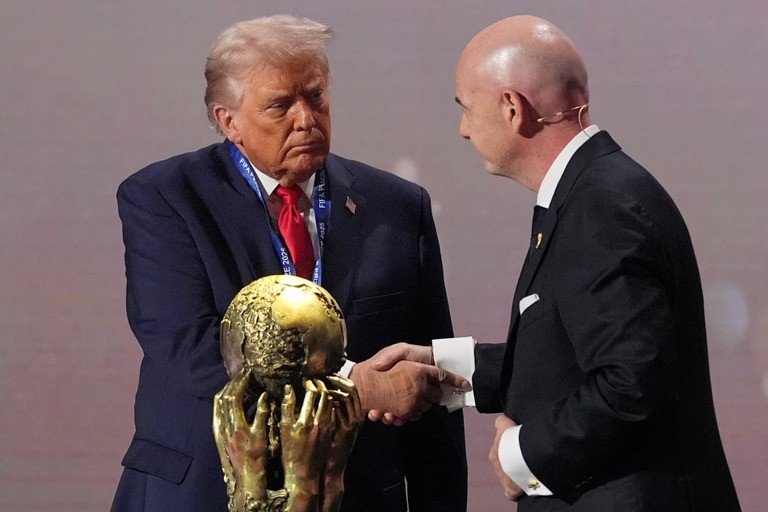
FIFA President Gianni Infantino has backed the independence of world football’s judicial bodies amid widespread debate over the decision to overturn the suspension of United States striker Folarin Balogun.
Despite admitting that he had addressed the topic with US President Donald Trump, he emphasized that the decision was reached autonomously through FIFA’s disciplinary processes.
The controversy broke out after FIFA’s independent Disciplinary Committee overturned Balogun’s red card suspension, prompting criticism from sections of the football community over the decision’s timing and speculation about possible political influence after Trump publicly claimed to have intervened on the player’s behalf.
Infantino responded on Monday with a statement emphasizing that FIFA’s judicial bodies operate independently of the organization’s leadership.
“I have seen the public comments regarding the decision of the independent FIFA Disciplinary Committee related to the suspension of Folarin Balogun, and I would like to reiterate a fundamental principle of FIFA’s governance.
“FIFA’s judicial bodies are independent. They operate autonomously, apply the FIFA Disciplinary Code, and decide cases based on the applicable regulations and the specific facts before them. Their independence is essential to the credibility and integrity of football, and this must always be respected,” Infantino said.
Infantino also mentioned he had spoken with Trump about the case but rejected suggestions that the conversation influenced the outcome.
“Yes, I regularly discuss matters related to the FIFA World Cup with the President of the United States, and on this matter, I did receive a call from President Donald Trump, just as I receive calls from heads of state, government officials, football stakeholders and business executives from around the world on many different issues.
“During our conversation, I explained that there was an ongoing legal process involving FIFA’s independent judicial bodies and that the case would be decided in due course by the competent bodies. That is how FIFA’s system works, and it is a principle that I will always uphold,” he said.
The FIFA president noted that while he may personally agree or disagree with disciplinary findings, he does not interfere with the functioning of the organization’s judicial organs.
“I read the decisions of the FIFA Disciplinary Committee when they are issued. Sometimes I am surprised by them. Sometimes I agree with them, and sometimes I disagree.
“What I always do, however, is respect those decisions and the autonomy of the bodies that make them. Whether we personally like a decision or not is irrelevant. Respect for independent institutions and the rule of law is what protects the integrity of our competitions and the credibility of FIFA at all times.”
The Balogun verdict reignited long-standing disputes about FIFA’s governance and the independence of its disciplinary procedures.
The football governing body has repeatedly maintained that its judicial bodies, including the Disciplinary Committee, Ethics Committee and Appeal Committee, operate independently from the FIFA Council and the president, a principle introduced and strengthened through governance reforms adopted in the wake of the corruption scandals that engulfed world football a decade ago.
Neither FIFA’s Disciplinary Committee nor its Appeal Committee has shown that any external representations influenced the ruling, maintaining that decisions are based solely on the FIFA Disciplinary Code and the evidence presented in each case.
The overturning of Balogun’s suspension means the US striker remains available for selection, while the debate over the balance between football governance, judicial independence and political access is likely to continue.