



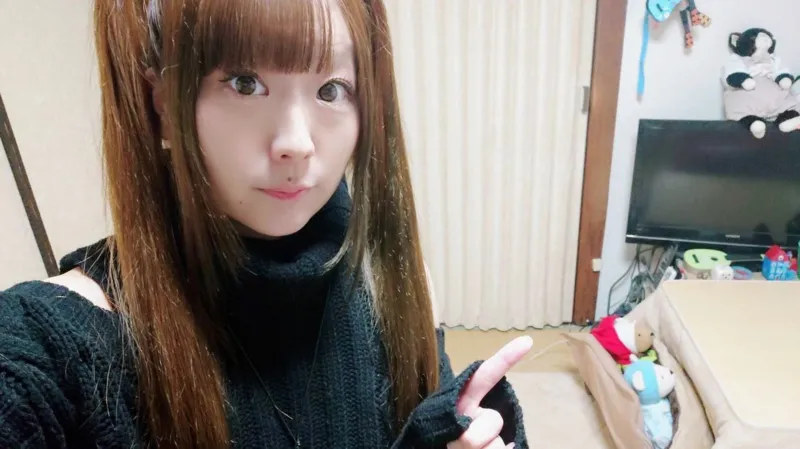
Ryua, a resident in Tokyo, Japan, has narrated how she knew her rental apartment was haunted from the moment she first walked into the building.
“When I visited the place for a viewing, there was a man standing there, glaring at me,” she says.
“Since the estate agent couldn’t see him, I realized he must be a ghost.”
While someone more easily spooked would likely have fled the flat quickly and never come back, Ryua decided to go ahead and move in.
“I’m a bit of a contrarian, so I decided I wanted to become friends with this glaring male ghost,” adds Ryua, who works as an aidoru, a young entertainer, and who doesn’t wish to share her surname.
Four years on, and still living in the same apartment, she says she keeps experiencing paranormal activity every day. She says she hears endless footsteps and the ghost talking.
Although Japan has increasingly embraced Halloween in recent years, many Japanese people take ghosts seriously all year round. The country has a word, “yuurei,” which refers to a lingering, troubled spirit.
These are the ghosts of people who died in violent or tragic circumstances—those who were murdered, took their own lives, or were simply lonely and died alone. If they died at home, the belief is that their yuurei will not go away.
For house hunters who are neither superstitious nor easily spooked, that means there are big bargains to be found. There is an entire category of dwellings known as “jiko bukken,” which means “stigmatized” or “incident” properties.
Under guidelines issued by the government in 2021, Japanese estate agents are required to disclose suicide, murder, death by fire, and any death where the body was not found for an extended period of time.
For rental properties this information must be disclosed for three years, and it must be revealed indefinitely for any property offered for sale.
By contrast, in the UK there is no legal obligation to reveal that a person died in a property. And in the US, it varies from state to state.
For instance, in California you must reveal if a person has died in the property in the past three years, while in Arizona and Oregon you do not.
Ryua was told that a man had killed himself in her apartment. As a result, she gets an almost 30% discount on her rent for her tiny, 25 sq m bedsit in the fashionable ward of Setagaya. She says she pays 45,000 yen ($285; £213) a month, rather than what should have been 62,000 yen.
While a house where a murder or suicide had occurred would probably be harder to sell or rent out anywhere in the world, Tokyo estate agent Erik Oskamp says that Japanese people are especially superstitious and averse to stigmatized properties.
“[Even] an apartment next to a cemetery will be difficult to rent out, especially if you can see the tombs from the kitchen,” explains Oskamp.
“The worst thing is if a suicide has happened in the apartment. Even if somebody has jumped from the roof, many renters will move out. Other issues are a serious crime or a lonely death.”
That second issue, a person dying alone, would not typically influence a property’s price in places like the UK or the US.
However, in rural Kagoshima in southwestern Japan, it allowed Diane Tincher to purchase a spacious three-bedroom house for roughly half of what the asking price would otherwise have been.
This 79-year-old American has been living in Japan for almost 40 years and works as a tour guide. She notes that the estate agent had been honest with her: there was a substantial discount because an elderly woman had died alone, which left the property stigmatized.
Tinker paid 20m yen for the house, in an area where comparable properties typically sell for as much as 45m yen.
“I don’t believe in ghosts. But I know that the Japanese are very superstitious,” she says. “If there is a ghost I’m thankful to her every day… to live in such a splendid and affordable home.”
While looking into the house, Tincher had come across it on a website named Oshimaland, which catalogs jiko bukken properties and provides details about the events that took place there. It launched in 2005 with coverage of Tokyo, then expanded throughout Japan before going international in 2011.
Because it is crowdsourced, members of the public are the ones who add the homes and their details.
Teru Oshima, the founder of Oshimaland, notes that in the past these kinds of properties were “not very attractive options” in Japan.
However, as house prices have climbed in the country in recent years, along with a major rise in the broader cost of living, a 2025 survey found that over half of Japanese people would now rent a jiko bukken if the price was low.
Back in Setagaya, Ryua says she is happy sharing her home with her ghostly flatmate.
“I believe that ghosts were once living human beings, so they deserve our respect,” she says.