



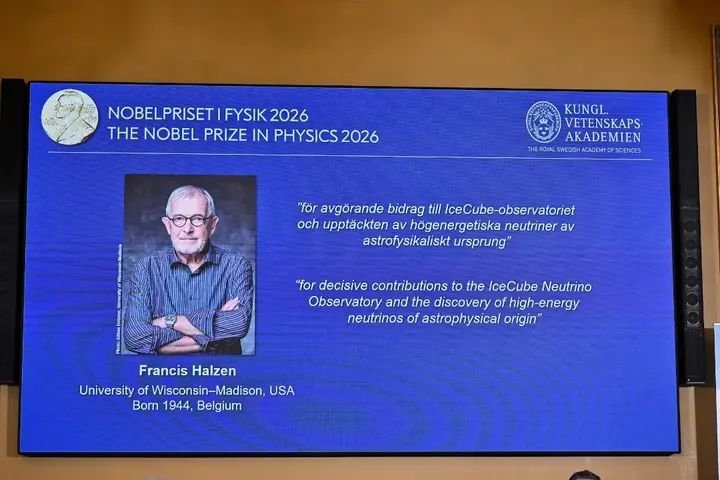
Belgian-American physicist Francis Halzen has won the 2026 Nobel Prize in Physics for his pioneering work on high-energy neutrinos and the IceCube Neutrino Observatory at the South Pole.
The Royal Swedish Academy of Sciences announced the award on Tuesday, recognising Halzen “for decisive contributions to the IceCube Neutrino Observatory and the discovery of high-energy neutrinos of astrophysical origin”.
Halzen, 82, is a professor at the University of Wisconsin-Madison in the United States. He was born in Tienen, Belgium.
The Nobel committee described his scientific vision and leadership as fundamental to the development of IceCube, a giant neutrino observatory embedded in about a cubic kilometre of Antarctic ice.
“This year’s prize is about ghostly messengers from space,” Ellen Moons, secretary general of the Royal Swedish Academy of Sciences, told a news conference.
How IceCube detects neutrinos
Neutrinos are electrically neutral subatomic particles that interact extremely weakly with matter, allowing them to travel vast distances through space and even pass through the Earth with little interaction.
IceCube uses more than 5,000 light sensors buried deep beneath the Antarctic ice to detect the rare flashes produced when neutrinos interact with matter.
The observatory has enabled scientists to study high-energy neutrinos originating from some of the most extreme processes in the universe, opening a new way of investigating distant cosmic events.
“This Nobel Prize is about a giant ice cube positioned at the South Pole of our globe. The ice cube enables the detection of neutrinos,” Eva Olsson, a member of the Nobel Committee for Physics, told reporters.
Halzen said he was surprised by the recognition.
“It was a great surprise, and I obviously didn’t expect it,” he told the news conference by telephone shortly after the prize was announced.
“But it’s a great pleasure to hear about this prize,” Halzen said.
Halzen first proposed using South Pole ice to detect neutrinos in 1988, while the IceCube observatory was completed in 2011.
The research has helped establish neutrino astronomy as a new way of studying the universe and tracing high-energy particles back to extreme astrophysical events.
Nobel Prize season continues
The physics award is the second Nobel Prize announced this week, following Monday’s Nobel Prize in Physiology or Medicine.
The Medicine Prize went to US scientist Karl Deisseroth and German scientists Peter Hegemann and Georg Nagel for discoveries concerning light-gated ion channels and optogenetics, a technique that allows scientists to control nerve activity using light.
The Nobel Prize announcements continue with chemistry on Wednesday, literature on Thursday and the Peace Prize on Friday. The economics prize will conclude the 2026 Nobel season on October 12.
The Nobel laureates will receive their medals, diplomas and prize money at formal ceremonies on December 10, the anniversary of Alfred Nobel’s death.
The 2026 Nobel Prize carries a monetary award of 12 million Swedish kronor, about $1.2 million.