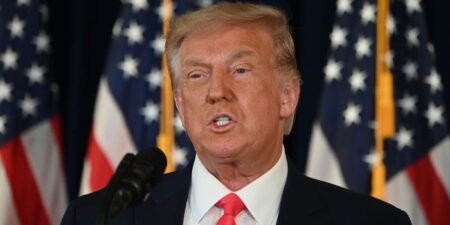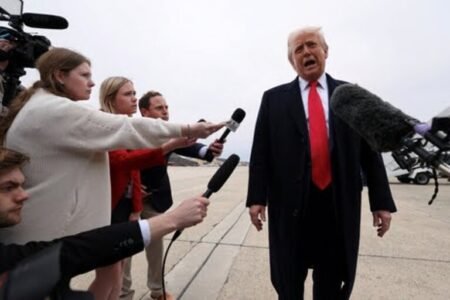




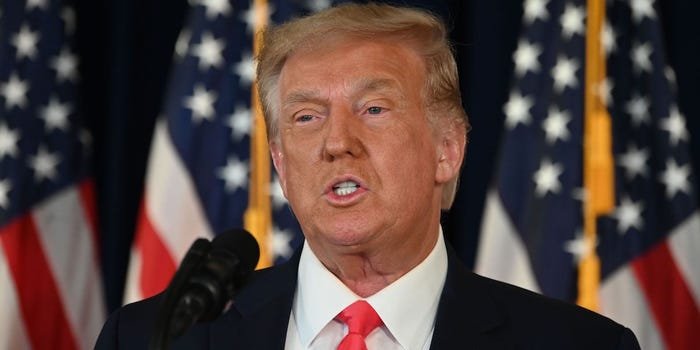
US President Donald Trump has dismissed the idea that his leadership and policies played a part in Republican defeats in the midterm elections, instead placing the blame on the party’s candidates for not doing enough to get voters to the polls.
The election results, which saw Democrats take control of both the House of Representatives and the Senate on Tuesday, have prompted questions about Trump’s political position and where his administration is headed for the rest of his term.
Although members of both parties saw the outcome as a rejection of Trump’s record in office, the president rejected the notion that the results amounted to a setback for him.
“But I don’t view it as a hit on me,” Trump told Fox News in a live phone interview.
“We’ve had the greatest two years in the history of the presidency in terms of the economy, in terms of all the things that we’ve done.”
Trump contended that the losses stemmed mainly from how individual Republican candidates performed, not from his administration’s policies, including the war in Iran and tariffs that have helped push prices higher.
He also pointed to what he called favorable media coverage of Democratic candidates, especially on Fox News, saying the election result came as only a “little surprise.”
“I thought they’d do better,” he said, referring to Republican candidates.
He later put the outcome down to a “mood in the air,” while insisting that his administration’s policy agenda would carry on despite the Democrats’ gains in Congress.
The election came after weeks of campaigning by Trump, who travelled to Republican-leaning states to rally support for candidates and urged voters to “pretend I’m on the ballot.”
El-Sayed wins Michigan senate poll to become first Muslim senator
Troy Jackson ends Susan Collins’ nearly 30 years in US senate
Yet the strategy did not produce the expected results, and Trump maintained that the candidates had not done enough to draw voters.
“They just didn’t inspire the people to get out and vote,” he told Fox News.
“And I wasn’t on the ballot. If I was on the ballot, they would have got out.”
A number of the losing candidates had received Trump’s endorsement, among them Darline Graham in South Carolina, Ken Paxton in Texas, Michael Whatley in North Carolina, and Mike Collins in Georgia.
Certain of these endorsements were also issued despite opposition from other Republican leaders. ↻
Yet Trump did not admit his part in choosing the candidates, as he criticized how they performed.
“I had no choice,” he said, defending his decision to support Paxton over incumbent Senator John Cornyn in Texas.
“When it wasn’t fashionable, he kissed my ass.”
In a statement on his Truth Social platform shortly before midnight, Trump indicated that he would publicly analyze the reasons behind the party’s losses.
“I’m going to become a political pundit, both good and bad, on the reasons these candidates won and lost!” he wrote.
He later criticized Texas Governor Greg Abbott, calling him a “Republican in name only” and accusing him of reverting to a political strategy that had failed before.
“He went back to his original formula, and it wasn’t pretty!” Trump wrote.
At around the same time, though, the president told Politico in an interview that he had no interest in assigning blame for the outcome.
“I don’t want to blame anybody,” he said.
“I just want to say, you know, it was a very interesting period of time. I watched with great interest and learned from it.”
Trump also said he was willing to work with Democrats, who will now wield greater influence over legislative decisions in Washington.
He said he had already spoken with some Democratic politicians, though he did not name them.
“You know, I have a lot of friends that are Democrats. Believe it or not, I’ve already spoken to some of them,” he said.
The president talked about seeking common ground with the opposition party, even though comparable pledges of bipartisan cooperation after Republican defeats in the 2018 midterm elections yielded little in the way of meaningful results.
At the same time, Trump brushed aside the idea that he regretted his choice to start the war in Iran, a matter that some Republicans have pointed to as a factor in the party’s weak electoral showing.
“I don’t think about it. I did the right thing,” he told The Wall Street Journal when asked whether he regretted the military action. I would have done it again.”