
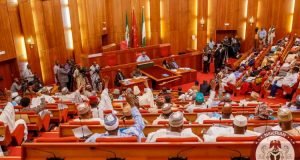




The Senate has given Nigerians its word that a law creating state police will be passed before the year ends, now that the constitutional amendment has been approved by the required 24 state Houses of Assembly.
This assurance followed the Ondo State House of Assembly’s passage on Monday of the Constitution of the Federal Republic of Nigeria, 1999 (Sixth Alteration) Bill, 2026, which is intended to set up State Police Services in Nigeria.
The lawmakers approved the bill at the plenary session once it had gone through the second and third readings, with every member in attendance backing its passage.
Earlier, Osun, Adamawa, Delta, Edo, Kwara, Nasarawa, Ogun, Oyo, Plateau, Rivers, Taraba, Zamfara, Enugu, Anambra, Imo, Ekiti, Kebbi, Akwa Ibom, Bayelsa, Benue, Cross River, Abia, Yobe, and Kaduna states had passed the bill, making the two-thirds constitutionally required for the passage by the National Assembly.
In an interview, Yemi Adaramodu, Chairman of the Senate Committee on Media and Public Affairs, stated that the National Assembly was resolved to wrap up the process before the Christmas break.
Adaramodu noted that the proposed legislation was a priority within the ongoing constitution review and would be taken up swiftly once the required proposals had been received from the executive.
“On the constitution review matter, we all know that the one on the front burner now is the state police bill.
“Already, we have promised Nigerians that before the end of this 10th National Assembly, a new police law will be enacted for Nigerians. And then, before we even leave for Christmas, it would have been done,” he said.
His assurance follows the submission of the draft National Policing Bill, 2026, along with 29 consequential amendment bills, by the Presidential Working Group on the National Policing Bill to the Ministry of Justice for legislative drafting review and validation.
According to the working group, which is chaired by the Chief of Staff to the President, Femi Gbajabiamila, the ministry is expected to return the validated drafts by October 30, after which the group will give them final consideration and present them to President Bola Tinubu for approval and subsequent transmission to the National Assembly.
Gbajabiamila had stated earlier that the proposed bill was 90 per cent ready and would be sent to the National Assembly on October 29.
Adaramodu, however, declined to comment on the executive’s proposed timeline, stating that the Senate would wait until it formally received the bills.
“Well, we cannot pass comment on what the executive said until we receive correspondence from them,” he said.
The Senate spokesman also brushed aside worries about delays in obtaining state-level approval for the constitutional amendment, clarifying that the 30 days were meant for state legislatures to submit their input.
“All those things (state approvals) will be brought to us, and we will put them under consideration because we are still going to hold a conference to address it.
“Again, you need to understand that the 30-day deadline is not for us. It is for the states to send in their inputs. And they have been doing that,” he said.
Adaramodu expressed confidence that the process would be concluded before the end of the year, insisting that the proposed law was necessary to strengthen the country’s response to insecurity.
“There’s nothing to worry about. The policing bill will be done expeditiously as we promised, and it will become law before the end of this year, by the grace of God. We are determined,” he said.
He also stated that lawmakers would ensure that relevant stakeholders had the opportunity to contribute to the proposed framework, given its implications for communities across the country.
“This is a popular bill. We know that it’s what Nigerians want and need. So, definitely we are not going to waste a minute on it.
“It’s only that we have to make sure that all stakeholders, critical ones, and even the ones that are not seriously critical, have input. This is because it concerns every community in Nigeria,” he said.
In his view, state police would enhance the enforcement of security laws and bolster efforts to address killings, abductions, banditry, and terrorism.
“We want to put an end to all these incessant killings, abductions, and activities of these marauders, bandits, and terrorists in Nigeria. So, we have enacted a lot of laws in the National Assembly to deter them. The only thing we need now is the enforcement.
“But if the state police are on the ground, enforcement will be better done and more effective than a centralized police force in Nigeria. So, that’s where all Nigerians are now. But as I said, it will be done expeditiously,” he added.
Speaking as well, the senator representing Anambra Central, Victor Umeh, said that the approval by 24 state assemblies meant the constitutional amendment had reached the required threshold and would go back to the National Assembly for verification.
“Well, now that 24 state assemblies have concurred on the state police bill, it will come back to us.
“What this means is that we have met the constitutional threshold. So, if it comes back to the Senate, we will verify all the things sent,” Umeh said.
He stated that the National Assembly supported decentralized policing because of Nigeria’s size and the need to bring security operations closer to communities.
“We in the National Assembly support state police for the simple reason that Nigeria is a very large country, so much so that policing it will require some level of decentralization.
“We cannot continue to have one central police force to provide security to Kebbi, Calabar, Sabon Gari, Ikot Abasi, and all the far ends of this country. No, we must decentralize it to have two police commands, especially state police, to get nearer to the grassroots,” he said.
Umeh stated that state-based policing would improve intelligence gathering and enable security agencies to respond more quickly to threats.
“That way, syndication of intelligence would be easy. This is because where you have a state commander for the state and the person is an indigene of the state, it is one good thing to achieve. It means people who are policing the various states are indigenes of those states,” he said.
He compared the proposed arrangement with the current centralized system, arguing that officers sent to states where they had little local knowledge might struggle to understand security threats in their areas of deployment.
He said state police commanders would be more familiar with local conditions and would face greater pressure to tackle security challenges in their jurisdictions.
“Every security issue is local. Through the intelligence of people in that state, we will be able to respond on time. Every criminal hides in the community, and there is a tendency they would be known to the locals,” Umeh added.
The proposed constitutional amendment aims to modify Section 214 of the Constitution, replacing the current Nigeria Police Force with a Federal Police Service and State Police Services.
On June 24, the Senate passed the Sixth Alteration Bill, and the House of Representatives followed suit. After that, on September 16, the National Assembly forwarded it to the 36 state Houses of Assembly for their consideration.
During the plenary in Ondo, prior to the bill’s passage, the Assembly’s majority leader, Mr. Olatunji Oshati, moved the motion for passage, which was seconded by Allen Oluwatoyin, who represents the Ese Odo state constituency.
Oshati stated that the lawmakers had thoroughly weighed the implications of the proposed amendment for the citizenry, noting that establishing state police would tackle the many security challenges facing the country.
In his remarks, the Speaker of the Assembly, Mr. Olamide Oladiji, called the proposed establishment of state police long overdue, noting that the “bill would enable security agencies to respond swiftly to crime and other security concerns.”
He said, “State policing would help reduce crime through improved intelligence gathering and proactive security measures.”
He subsequently instructed the Clerk of the House, Mr. Benjamin Jaiyeola, to forward the document to the National Assembly together with the observations of the state legislature.