



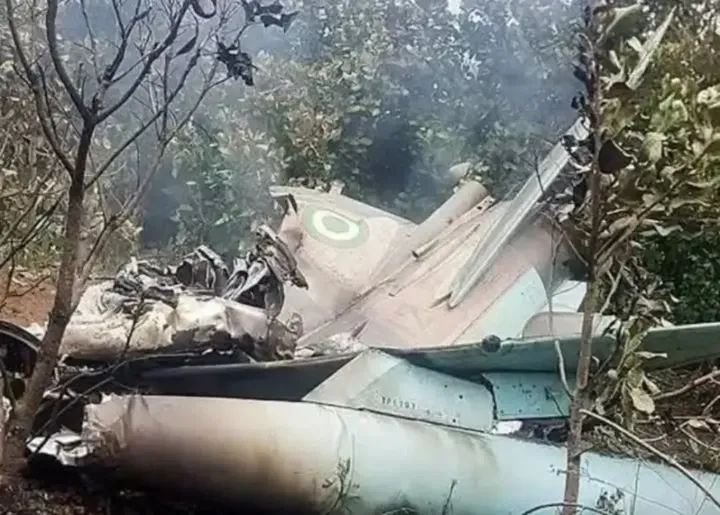
Twelve days after a Nigerian Air Force (NAF) aircraft crashed into the waters of Igbokoda, Ondo State, fishermen, fish traders and boat operators are struggling to feed their families as their livelihoods suffer from disrupted fishing activities and suspected water pollution.
The Chairman of the Ilaje Fishermen Association, Igbokoda, Festus Ikuomola, said about 1,500 members had been affected by the October 5 crash involving an aircraft carrying 25 people.
He said many fishermen had been unable to work since the incident, while those travelling farther to fish faced additional expenses that reduced their earnings.
“Normally, our people make between N15,000 and N30,000 on a good day, but most of them have not been doing anything since that day. Only a few who have bigger boats go far away to fish and return to sell, which is not economically viable if you compare how much they spend and what they make,” Ikuomola stated.
He called on the Federal Government to clean up the affected area and compensate residents whose livelihoods had been disrupted.
“The spillage will have a devastating effect on fish and other aquatic life in the area, thereby threatening our only source of livelihood,” the chairman said.
Ikuomola added that the disruption had also affected women who depend on fishing activities for their trading businesses and household incomes.
Fish traders struggle as supplies dwindle
According to Ikuomola, women dominate fish trading in the community, with many relying on the business to feed their families.
He estimated that the traders earned an average of ₦60,000 weekly before the incident, depending on the quantity of fish supplied by fishermen.
However, the crash has compounded existing challenges, including inadequate storage facilities, limited capital, poor access to credit and long distances to markets.
“The situation has been made worse by waterway contamination and military restrictions. Some fishermen said they saw oil floating on parts of the water, and restrictions on movement have also limited their access to fishing locations,” he added.
Boat operators have also suffered financial losses, forcing some to seek alternative sources of income.
One of them, Yemi Adetimehin, said he previously earned between ₦30,000 and ₦50,000 daily by transporting women who bought and sold fish.
“Right now, nothing is coming in for me. The soldiers have stopped us from entering the water,” he said.
Another boat operator, Shola Michael, said he had taken up commercial motorcycle riding to provide for his wife and two children after restrictions on the waterways forced him to abandon his business.
“I have a wife and two children who will eat. Since I can no longer use my boat for business because of the plane crash, I had to collect a bike to ride and make money to feed my family,” he said.
‘We now struggle to get fish’
A dry fish trader, Bimpe Kayode, said she had struggled to obtain sufficient supplies since the crash because fishermen were no longer going out as frequently as before.
“Last Sunday, I went to the market to buy fish, but very small quantities were available at the market in Igbokoda because we learnt that the fishermen did not go to the water to fish due to the incident that happened. So, I went back home empty-handed,” she added.
A fisherman who identified himself simply as Sunday said he now travelled farther from the community to catch fish, describing the journeys as strenuous.
“We could not get better fish around this area again because the water is no longer good. I have to go very far from here to catch fish, and this is very strenuous, unlike before. In fact, something has to be done about this matter; it is affecting our business,” he added.
Although fishermen have attributed their difficulties to the crash and suspected pollution, the extent of any contamination and its effects on aquatic life have yet to be established by the relevant government agencies.
The Ondo State Government had announced plans to test air and water quality at the crash site. Residents and fishing representatives are demanding clear information about the safety of the waterways, potential clean-up measures and compensation for affected people.
The Nigerian Air Force has also acknowledged residents’ concerns about offensive odours and possible environmental effects.
It said it would engage environmental and public health authorities after the recovery operation to assess the situation and address any concerns identified.
Igbokoda monarch petitions Tinubu
The Olugbokoda of Igbokoda, Oba Afolabi Odidiomo, has urged the Federal and Ondo State governments to intervene over environmental concerns and the economic losses reported by residents.
In a petition to the Presidency, the monarch raised concerns about the recovery of the aircraft and human remains, possible fuel leakage and the implications for aquatic life and communities whose livelihoods depend on the waterways.
“There are grave questions about the recovery of the aircraft and any human remains, the possible release of aviation fuel or other hazardous substances, and the effect on the surrounding waters, aquatic life, and people whose livelihoods depend on them,” he said.
The monarch maintained that residents should not be left to speculate about the safety of their waters or bear the consequences of any damage caused by an incident involving a Federal Government aircraft.
He called for an environmental assessment by qualified personnel and a transparent process through which affected residents could seek compensation for established losses.
“We want the government to put in place a fair and accessible claims process for persons who can demonstrate loss or injury attributable to the incident, covering damage to property and equipment, loss of income, reasonable expenses, personal injury, and other established losses recognised by law,” the monarch added.
The Ondo State Commissioner for Environment, Tob Loko, said the government would conduct air and water quality tests at the crash site to determine the extent of possible contamination and guide its response.
He said Governor Lucky Aiyedatiwa had directed him and the Commissioner for Health to expedite measures to address possible environmental pollution.
Loko added that officials would assess the site before deciding on the appropriate measures to protect residents and their livelihoods.
“That is why we are mobilising to the site for the spot assessment. We are going to assess the level of contamination that has taken place,” he assured.
Experts demand scientific tests on waterways
Fisheries and environmental experts have called for scientific testing to establish the extent of any pollution linked to the crash and determine the measures needed to restore the affected environment.
Dr Lukman Agbabiaka, an adviser and member of the Bureau of the African Network of Non-State Actors in Fisheries and Aquaculture, said an environmental impact assessment would help establish the concentration of hydrocarbons, aviation fuel and engine oil in the affected area and their potential effects on fisheries.
“The EIA report at the scene of the NAF aircraft crash in Ondo will guide on the toxicity and concentration of hydrocarbons, jet fuel, engine oil, and their potential impacts on the fishery in particular, including its multiplier effects,” he said.
Agbabiaka warned that fears of contamination could hurt fish sales even before scientific tests establish the extent of any environmental damage.
“In the short run or medium term, many aquatic foods from the area will be rejected by consumers with the fear of contamination and public health implications,” he added.
He estimated that the recovery of affected aquatic life and fishing grounds could take between six months and 10 years, depending on the type and concentration of pollutants, the species affected and the duration of exposure.
Philip Jakpor, an environmental expert and Executive Director of the Renevlyn Development Initiative, called on the government to conduct an environmental audit, address any pollution identified and provide alternative water supplies and livelihood support for affected residents.
“Aviation fuel, just like other hydrocarbons in an environment, will not disappear by mere fumigation, and the toxic elements can remain in the environment for decades,” he said.
Jakpor cited the United Nations Environment Programme’s 2011 assessment of oil pollution in Ogoniland to illustrate the potential long-term consequences of environmental contamination.
Professor Olawale Adejuwon, a Professor of Environmental Toxicology and Aquatic Pollution at Ladoke Akintola University of Technology, said the assessment should include tests on water, river sediments and fish tissue.
“No authority should declare the river safe without three levels of scientific testing: water analysis, sediment testing and fish-tissue analysis,” he warned.
Adejuwon questioned whether fumigation and the distribution of nose masks would adequately address possible hydrocarbon pollution.
“Fumigation kills mosquitoes and bacteria; it does not remove benzene from water. Nose masks only reduce inhalation for a few hours. What is needed is containment with oil booms, skimming, and bioremediation,” he said.
Muhammed Shehu, a toxicologist at the University of Abuja, also urged relevant environmental authorities to collect samples and have them analysed in accredited laboratories before deciding whether fishing could safely resume in the affected areas.
Families lament delay in recovering victims’ remains
As residents grapple with lost livelihoods and uncertainty over the condition of the river, relatives of some of the 25 people on board the aircraft have expressed anguish over the delay in recovering and identifying their loved ones’ remains.
Damilola, a sister of one of the victims, Sunday Michael, said her family had yet to receive adequate information about when her brother’s remains and those of the other victims might be recovered.
“It is heartbreaking that over a week after the crash, the bodies of the victims have not been recovered. Our family is really devastated by the situation.
“Nobody has provided us with any information about the recovery of the bodies. We don’t know what is happening or when the bodies will be found. We have been left in the dark, and we don’t even know what to expect,” she lamented.
Another victim’s sister, who identified herself as Perfection, said the lack of updates had compounded her family’s grief.
“At least, the recovery of the body will give the family some form of closure, but there is nothing we can do about it. The family is unable to plan for burial arrangements because nobody has been found till now. We have accepted our fate. There is no update,” she said.
The incident has left fishing communities facing mounting economic losses while families of the victims await answers. Residents are seeking clear findings from environmental assessments, appropriate action on any confirmed contamination and support for those whose livelihoods have been disrupted.