


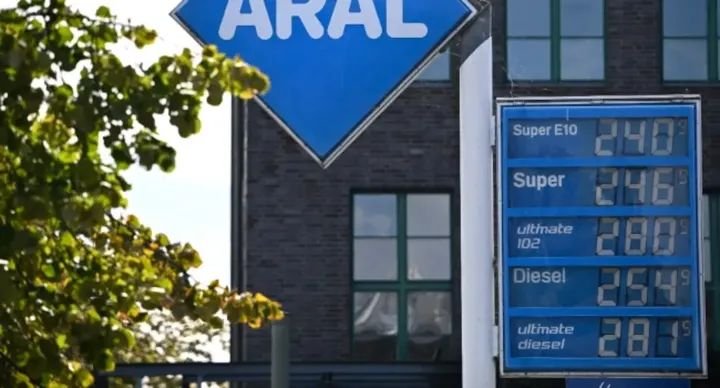
German motorists began paying less at petrol stations on Thursday after a new government fuel subsidy took effect, offering temporary relief from soaring energy costs linked to the Middle East conflict.
Petrol prices fell by about 14 cents per litre to an average of €2.06, while diesel dropped by around 15 cents to €2.20, according to Germany’s automobile association, ADAC.
The German government has reduced the energy tax on petrol and diesel by 14.04 cents per litre from October 1 to December 31, 2026. Including the resulting reduction in value-added tax, the total relief is expected to be about 17 cents per litre.
The measure is part of a €2.5 billion relief package designed to ease the pressure on households and businesses as fuel prices remain elevated amid disruptions to energy supplies from the Middle East.
Motorists question impact
Some motorists said the reduction was welcome but insufficient to ease the pressure of high fuel prices.
“It’s just a drop in the ocean,” Andrea Hoecker, a 33-year-old public relations worker, told AFP at a petrol station in Frankfurt.
“It helps in the short term, but in the long run I don’t think you can solve the problem with it,” she said.
Lorena Konle, a teacher, also described the prices as “unsatisfactory”.
“I have to be completely honest: with the prices we have, it doesn’t really make a difference,” she said.
Concerns over fuel discount
Motoring organisations have raised concerns about whether motorists will receive the full benefit of the government’s relief.
The official tax relief amounts to about 17 cents per litre, although the amount reflected at petrol stations can vary depending on oil prices, exchange rates and market conditions.
The ADAC has called for the reduction to be fully passed on to consumers during the first days of October.
A previous fuel relief programme earlier in 2026 also prompted scrutiny over how much of the tax reduction reached consumers.
Economists raise targeting concerns
Some economists have questioned whether a broad fuel discount is the most targeted way of supporting households facing higher living costs.
Clemens Fuest, head of the Ifo Institute, told the Augsburger Allgemeine that the measure benefits frequent drivers and owners of larger vehicles.
“The fuel discount leads to redistribution in favour of frequent drivers with large cars,” Fuest said.
The German government says the temporary tax cut is intended to support citizens and businesses affected by high fuel prices, including commuters, families, logistics companies and other businesses.
Germany also plans talks with the oil industry on a temporary fuel price cap, with the government targeting implementation by January 2027.
Other European Union countries have introduced measures including fuel-tax reductions, discounts and direct payments to help households and businesses cope with rising energy costs.