



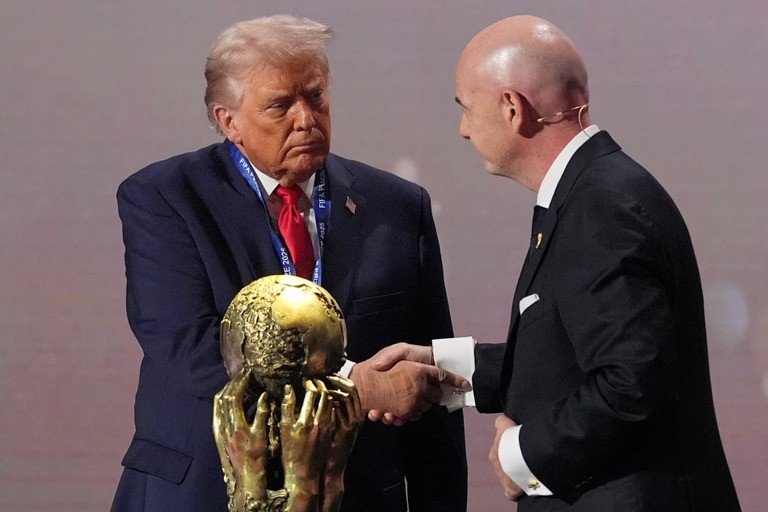
US President Donald Trump said Monday that replacing Gianni Infantino, the embattled FIFA president who attempted and failed to sell off a portion of the World Cup to private investors, would be a “terrible mistake”.
Infantino came under further assault in an open letter signed by three confederations: Europe’s UEFA, North and Central America’s CONCACAF, and Asia’s AFC, accusing the international football head of breaching trust “through deception”.
However, Trump supported Infantino, who presented the US president with a “FIFA Peace Prise” during last year’s World Cup draw event.
“FIFA would be making a terrible mistake if, for any reason, they even considered replacing President Gianni Infantino,” Trump posted on Truth Social.
Trump described Infantino as “fantastic” and stated that he “presided over the most successful World Cup, by four times, ever presented”.
“If he is gone, it’ll never be as successful or profitable again!” said Trump, who accompanied Infantino to the World Cup final last month. It would be “a terrible mistake” to replace Gianni Infantino, the embattled FIFA president who tried and failed.
Trump’s support for Infantino contradicts US Soccer, which has joined the chorus of criticism against the FIFA president.
Infantino proposed, then abandoned, a plan to integrate private investment into FIFA competitions, including World Cups.
FIFA responded on Saturday to efforts to “undermine” football’s governing body and Infantino.
However, in a joint letter sent Monday, UEFA, CONCACAF, and the AFC said, “Leadership in football is not a possession.” It is neither about holding power or insisting that it be held.
“When trust is broken through deception, when an individual places himself above the collective that entrusted him with authority, that duty has been abandoned.”
CONCACAF president Victor Montagliani is considered a potential contender to Infantino, who will seek re-election for a fourth and final term at the FIFA Congress in March 2027. Candidates must be declared before November 18.
Infantino appeared to be uncontested for a fourth term after directing a successful World Cup in the United States, Mexico, and Canada until his plans were uncovered.
The 56-year-old Swiss, who has been in place for ten years, has the support of the Confederation of African Football, while the South American regulatory body CONMEBOL is mostly favourable.
Individual member associations, not confederations, vote in the FIFA elections.
Infantino has garnered backing from CONCACAF member Mexico, as well as two AFC members, Kuwait and Qatar, who will host the 2022 World Cup.
UEFA’s warning to boycott World Cups if the private investment plan went ahead was instrumental in Infantino abandoning his sell-off scheme.
UEFA had labelled it “a shabby, opaque, backroom deal” and chastised Infantino again on Monday for a “failure of judgement”.
Following the controversy, Infantino gained “full support” from senior FIFA directors at an emergency meeting in Morocco last week, but the three confederations deemed this irrelevant.
The recent meeting, attended by ‘a small number of members of the FIFA Management Committee’, they stated, ‘represents a continuation of the precise pattern of conduct that brought us to this juncture.’
“It is not the conduct of a custodian of the game but of one who believes the game is answerable to him.”
Infantino had been enjoying the afterglow of the largest-ever World Cup involving 48 teams before his intentions divided the sport.
“The growth over the past decade has been real, but that progress was never the work of one individual. It was the product of FIFA, the Confederations, the Member Associations, and the thousands of people who dedicate their lives to the game.
“The expanded tournaments… were shared achievements, agreed together, delivered together,” declared the letter.
Under Infantino’s leadership, “There is silence where there should be accountability and distance where there should be openness. That is why we have taken this stance: not lightly and not alone, but together, and out of duty to the game we serve.
“Football’s strength has always been its unity,” they said.