




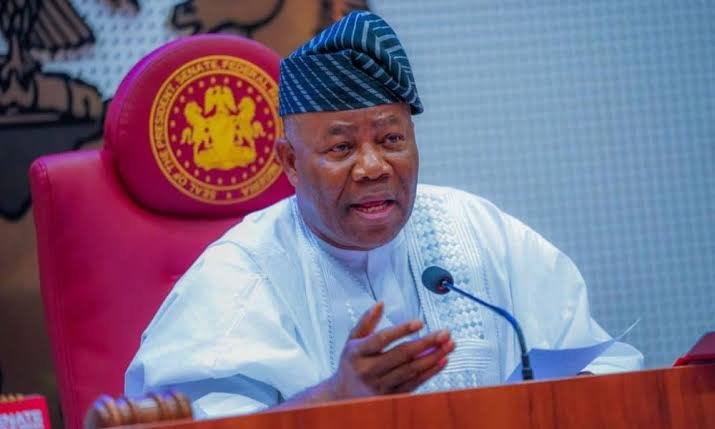
The Senate has specified that the contentious rule imposing penalties for preaching, hawking, and trading within commercial vehicles is not a new effort to ban religious activities or street evangelism but rather a longstanding provision of the Federal Road Safety Commission Act that has been in effect since 2007.
The explanation comes after significant public anger regarding the approval of the Federal Road Safety Corps (Amendment) Bill, 2026, which suggests a N50,000 penalty for those found guilty of hawking, selling, or preaching within commercial vehicles.
The suggested law, part of a larger assessment of the FRSC Act intended to enhance road safety enforcement and decrease road accidents, faced criticism from Christian organizations, opposition parties, civil society groups, and the general public, with many claiming that the measure was insensitive in light of increasing unemployment and deteriorating economic conditions.
In a statement released on Monday, Senate Leader Opeyemi Bamidele clarified that the disputed provision had been misinterpreted, asserting that the amendment did not create a new offense nor aimed to restrict preaching in public areas.
He said, “The Senate has duly noticed public concerns on the purported proscription of preaching and hawking in a commercial vehicle under the ongoing amendment to the Federal Road Safety Commission (Establishment) Act, No. 22, 2007.
“Pursuant to Section 10(4) of the Federal Road Safety Commission (Establishment) Act, 2007, and Regulation 220 of the National Road Traffic Regulations (NRTR) 2012, preaching and hawking in a commercial vehicle are offenses. The offenses have been part of the act before the current amendment.
“Entrenched as Item 36 in the Second Schedule of the Act, preaching and hawking in a commercial vehicle are not new provisions in our legal system.
“The provisions have been part of the Act as far back as 2007. However, it is now listed as Item 49, Second Schedule of the Act.”
The Senate emphasized that the legislation was strictly targeted at promoting road safety and protecting commuters from distractions that could endanger lives.
“The bill, therefore, does not outlaw preaching on the streets as some interests have claimed in different fora. It is about the safety of commuters and other road users and not intended to undermine any religious activity in the public space,” he added.
The Senate also denied reports linking the amendment to Bamidele, saying the legislation originated from the House of Representatives.
“The bill is not an initiative of the leader of the Senate, Senator Opeyemi Bamidele. Rather, it is a concurrence bill first amended by the House of Representatives.
“As required by the 1999 Constitution, the bill requires the concurrence of the Senate before it can become effective.
“The amendment process is still ongoing. In the spirit of democracy, stakeholders can channel their concerns to the appropriate institutions before the completion of the process,” he stated.
The explanation arrives shortly after the Senate approved the Federal Road Safety Corps (Amendment) Bill, 2026, aimed at enhancing road safety enforcement with harsher penalties for traffic violations.
In addition to implementing a N50,000 penalty for individuals found guilty of hawking, trading, or preaching in commercial vehicles, the bill also suggests a N50,000 fine, six months in prison, or both for drivers who do not comply with FRSC officials performing roadside breath tests based on reasonable suspicion.
It also increases the fine for operating a vehicle while impaired by alcohol or drugs from N5,000 to N100,000, with violators risking up to two years in prison or both.
In the same way, the suggested law raises the fine for ignoring traffic lights, road signs, pavement markings, and other traffic control devices to N100,000, while violations of speed limits and reckless driving would incur harsher penalties, such as fines of N100,000 and, in certain situations, imprisonment.
The updated list of offenses includes 52 traffic violations along with their respective penalties, as legislators indicate that the changes aim to boost adherence to traffic laws, bolster the FRSC’s enforcement authority, and improve road safety across the country.
Prior to Monday’s clarification, opposition parties criticized the suggested penalties, contending that making hawking and preaching in commercial vehicles illegal was inappropriate while many Nigerians faced rising inflation, unemployment, and diminishing purchasing power.
Party officials described the proposal as insensitive, urging the National Assembly to prioritize legislation that addresses the country’s economic challenges rather than imposing harsher penalties on struggling citizens.