


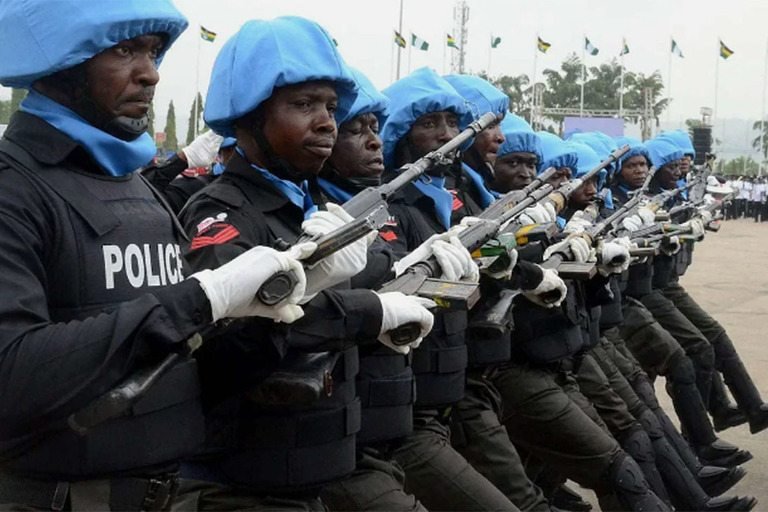
Despite the consensus across the country on the establishment of state police, some voices are still attempting to reverse the hope-filled efforts toward the most sensible steps to tackle the seemingly intractable insecurity scourge threatening the nation.
Those pushing back are relying on the same profitless arguments—what I have repeatedly called the same shibboleth, the same beaten track, the same old hat: that all Nigeria needs is increased funding, more training, and a larger numerical strength of the federal police under the current system.
I sincerely hope President Bola Tinubu will not feel intimidated or back down. He is on the right path toward rescuing the nation from the chokehold of terrorists, bandits, kidnappers, and their sponsors.
Tinubu has consistently made the right pronouncements on the imperative of state police since assuming office. Last week, he urged the National Assembly to begin reviewing the laws to allow states willing to establish state police to do so. Earlier in June, he declared: “State police is no longer optional but a national imperative.”

This followed the Northern Establishment—governors, traditional rulers, and key stakeholders—throwing their full support behind the initiative. They reaffirmed their position again this week in Kaduna. The South-West Establishment has done the same. The Conference of State Assembly Speakers has also expressed readiness to give all necessary legislative backing.
Tinubu’s June speech at the high-level Legislative Dialogue on Nigeria’s National Security Architecture, delivered on his behalf by then Defence Minister Mohammed Abubakar Badaru, highlighted the urgency: “The debate over state police is no longer theoretical. It is grounded in the daily fears and lived anxieties of Nigerians—farmers afraid to tend their fields, traders unsure of safe passage, and communities abandoned to self-help.”
He noted that the current centralised security system has outlived its usefulness. Failure to align the constitution with Nigeria’s security realities, he warned, could pose a grave threat to national unity. While acknowledging the importance of the 1999 Constitution, he stressed its outdated capacity to address modern threats such as terrorism, cybercrime, farmer-herder conflicts, piracy, and separatist agitations.
According to him: “These are clear indications that the current legal framework is inadequate to secure Nigeria’s vast and diverse territory. Our constitution must evolve or risk becoming a danger to the very unity it is meant to protect.”
He therefore pressed for constitutional amendments to move policing from the Exclusive Legislative List to the Concurrent List, enabling capable and willing states to establish their own police forces. Such a reform, he said, would promote accountable, community-based policing while maintaining federal coordination. “We must learn from global best practices, adapting decentralised models that enhance local accountability without sacrificing national oversight.”
Tinubu also outlined proactive steps already taken to protect vulnerable citizens, especially schoolchildren, including the creation of the National Safe Schools Response Coordination Centre and the approval of a community policing framework. But he stressed that without constitutional backing for decentralised policing, these efforts would remain limited.
He challenged the National Assembly—particularly the House Committee on Constitutional Review chaired by Deputy Speaker Benjamin Kalu—to act courageously and urgently. “Let history record that in this chamber, on this day, Nigerian leaders chose courage over caution, vision over fear, and reform over inertia.”
Profound. Convincing. Enheartening.

Some argue that governors may misuse state police, but former head of state Ibrahim Babangida dismissed such fears as unfounded in today’s rights-conscious Nigeria. The civilisation of governance, he argued, must not leave Nigeria behind.
Another argument questions how states struggling to pay salaries can fund armed state police. But this is a classic chicken-and-egg dilemma. Without security, citizens cannot work, earn income, or pay taxes to government coffers. The logical sequence is clear: establish state police → ensure peace → enable economic activity → generate revenue → pay workers.
Importantly, the constitutional amendment will not compel all states to set up state police. States afraid of potential misuse may wait until they are ready or have governors they trust. As former Governor Jonah Jang noted, Nigeria is a federation—mixing unitary and federal structures will never work. In the First Republic, the Eastern Region did not have a regional police force, yet the Western Region had a three-tier system.
It is also crucial to state that if just five of thirty-six governors might abuse their police, that is no justification to deny responsible governors the right to protect their states. Joseph Daudu, former NBA President, insisted it would be unfair and unjust to tie the hands of those ready to confront insecurity frontally.
People—including governors—are at different levels of maturity. Those less mature must learn from those ahead. And state police does not abolish the Nigeria Police Force; rather, guidelines will define collaboration and operational boundaries between both.
Tinubu’s drive for the establishment of state police deserves full national support. It is sound, sensible, and the most convincing path toward the security, development, and progress of Nigeria.