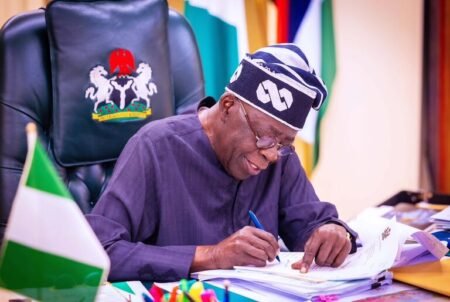




President Bola Tinubu has declared that Nigeria’s economic reforms are now irreversible after formally accepting the presidential ticket of the All Progressives Congress (APC) for the 2027 election.
Speaking in Abuja on Sunday, Tinubu urged Nigerians to renew his mandate for another four years, insisting that the country must not return to what he described as years of economic waste and instability.
In a speech that signalled the official start of his re-election campaign, the President defended his administration’s policies despite growing public frustration over inflation and the rising cost of living.
Tinubu said difficult reforms introduced since he assumed office were already producing positive economic results.
“We moved away from wasteful fuel subsidies, unstable exchange rates, and weak infrastructure. Today, we are witnessing a turnaround,” he said.
The President pointed to the removal of fuel subsidies, exchange rate reforms, improved government revenue, and fiscal restructuring as key measures aimed at stabilising the economy.
He also highlighted projects in education, electricity, road infrastructure, and the oil and gas sector, including the student loan scheme, electricity metering rollout, and ongoing highway construction projects across the country.
On insecurity, Tinubu admitted that security challenges remain in parts of Nigeria but promised that his administration would intensify efforts to restore peace and stability nationwide.
He also backed the creation of state police, describing the move as a national emergency requiring urgent attention.
In what appeared to be a direct attack on opposition parties ahead of the 2027 election, Tinubu warned Nigerians against supporting politicians who, according to him, lack a clear vision for the country.
“This next election must not merely be a contest of parties or ideas, but a reaffirmation of Nigeria’s democratic maturity,” the President stated.
The speech formally positions Tinubu for the 2027 presidential race and is expected to shape political debates around the economy, governance, and security in the coming months.