


The Minister of the Federal Capital Territory (FCT), Nyesom Wike, has defended the high cost of billboard advertising in Abuja ahead of the 2027 general elections, insisting that political campaigns are expensive worldwide.
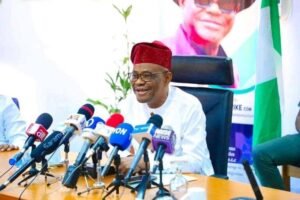
Wike spoke on Thursday during his monthly media chat in Port Harcourt, Rivers State, following complaints by opposition parties over the rising cost of securing billboard spaces in the nation’s capital.
Some opposition parties have expressed concerns that the high charges could limit their ability to publicise candidates and campaign messages, particularly as billboards belonging to the All Progressives Congress (APC) reportedly dominate major cities.
Reacting to the complaints, Wike argued that the increase in billboard charges was driven by the FCT Administration’s revenue-generation objectives and was not intended to disadvantage opposition parties.
“Politics is expensive all over the world,” he said, adding that political parties could leverage their social media platforms to reach voters.
The minister maintained that billboard advertising was an important revenue source for the FCT Administration.
“We want money. The FCT wants money, and part of us making money is through the billboards to raise our revenue.
“If we know that in a given time, people will rush the billboard and authority feel that we will raise the funds to make more money,” he said.
Wike insisted that the increased charges were not targeted at any political party, explaining that the revenue generated would support infrastructure development across the territory.
“The authority did not raise funds against you, because it is you,” he said.
He added: “I am going to use the money to do more roads, to improve the schools.”
Wike: Billboards Do Not Win Elections
The FCT minister also played down the importance of billboard advertising in determining election outcomes, arguing that political parties should not rely exclusively on the medium to attract voters.
“For Christ’s sake, a billboard does not win an election; how many people in the villages know about the billboard?” he asked.
Addressing concerns about equal access to campaign platforms, Wike argued that political parties also spend significant amounts securing premium advertising slots in media organisations.
He maintained that the FCT Administration was primarily interested in collecting revenue rather than determining which political parties secured billboard spaces.
“People go and pay a year ahead for billboards, ‘how will I know?’ My business is not going to ask, who and who paid for the billboard; I have no business there,” he said.
Wike also challenged opposition parties alleging discrimination to formally approach the FCT Administration with their complaints.
“Let them complain to us; no one has complained to us. Nobody has complained to me,” he added.