


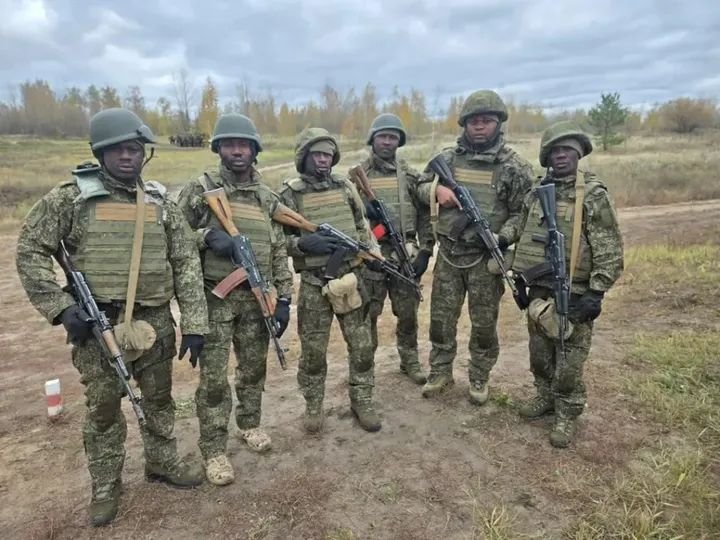
The United Kingdom (UK) has imposed fresh sanctions on Russian-linked networks accused of recruiting Africans and Middle Easterners, including Nigerians, to fight in the war in Ukraine.
In a statement released by the Foreign, Commonwealth & Development Office, the UK government said 35 individuals and entities had been sanctioned over activities linked to Russia’s military operations and drone production.
Among those sanctioned is Polina Alexandrovna Azarnykh, who the UK said was backed by the Russian state and involved in facilitating the movement of recruits from countries such as Nigeria, Egypt, Iraq, Morocco, Syria and Yemen into Russia before deployment to the Ukrainian frontline.
According to the UK authorities, the recruits were allegedly sent into combat with little training and under harsh conditions to support Russia’s war effort.
The sanctions follow growing scrutiny over reports that Africans were being lured to Russia with promises of civilian jobs, including positions as drivers and security guards, before allegedly being drawn into military service.
Earlier this year, Andrey Podyelyshev, Russia’s ambassador to Nigeria, denied claims that the Kremlin was recruiting Nigerians to fight in Ukraine.
The controversy intensified after Ukrainian authorities reportedly discovered the bodies of two Nigerians in the Luhansk region who were allegedly fighting for Russian forces.
Some Nigerians currently in Russia have also appealed to the federal government for repatriation, claiming they were deceived into joining the Russian army.
Reacting to the sanctions, Stephen Doughty described the recruitment scheme as exploitative.
“The practice of exploiting vulnerable people to prop up Russia’s failing and illegal war in Ukraine is barbaric,” Doughty said.
He added that the sanctions were aimed at disrupting networks trafficking migrants and supplying components used in Russia’s drone production.
The UK also targeted organisations linked to weapons manufacturing, including networks accused of recruiting foreign migrants to work in drone factories through programmes such as Alabuga Start.
According to the UK government, Russia launched more than 200 drones per day into Ukraine during March 2026, marking its highest monthly total since the war began.
Some sanctioned entities were reportedly based in China and Thailand, where they were accused of supplying drone components and military-related materials to Russia.
Among those named was Pavel Nikitin, whose company allegedly develops Russia’s VT-40 attack drone, described by the UK as a low-cost, mass-produced weapon widely used in attacks on Ukraine.
The UK government said it would continue supporting Ukraine and working to disrupt Russia’s military supply chains and recruitment networks.