


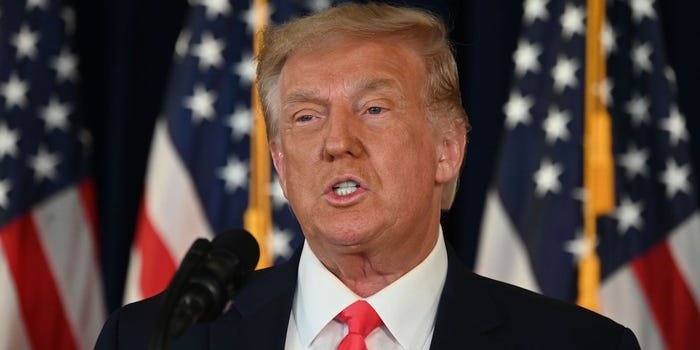
United States President, Donald Trump, has threatened to launch strikes on Iran’s bridges and power plants unless Tehran returns to negotiations.
Speaking during a recent interview with Fox News, Trump warned that Iran would face more devastating attacks if it refused to resume talks with Washington.
“Next week it gets really bad for them,” Trump said. “We’re going to knock out all their power plants. We’re going to knock out all their bridges unless they get to the table and negotiate.”
He also said: “I’ll save the energy targets for last, but ultimately we’ll hit energy targets.”
According to Trump, US negotiators had delivered a stern message to Iranian officials on Tuesday evening, saying they had “better make a deal, or you’re not going to have anything left.”
The latest threat comes amid renewed fighting between the two countries. Earlier, Trump withdrew his proposal to impose a 20% fee on cargo passing through the Strait of Hormuz, saying the United States would instead pursue “massive” trade and investment agreements with Gulf states.
The US Central Command (Centcom) said it carried out a seven-hour operation targeting dozens of Iranian military sites near the Strait of Hormuz.
The military said the strikes were aimed at further degrading Iran’s ability to threaten commercial shipping and civilian crews operating in the strategic waterway.
Iran’s army said at least seven military personnel were killed during US strikes on a military base in the southeastern city of Bampur.
In response, Iran launched missiles and drones at US targets in Jordan, Kuwait and Bahrain, according to Iranian state-run television. The militaries of Kuwait and Bahrain later confirmed they had intercepted and destroyed the incoming aerial threats.
Centcom also accused Iran of deliberately targeting civilians by attacking seven commercial vessels, saying the attacks left nearly a dozen crew members dead, injured or missing.
The United Arab Emirates said Iranian cruise missiles struck two of its oil tankers, killing an Indian crew member and injuring eight others, four of them seriously.
Iran’s Islamic Revolutionary Guard Corps (IRGC) later confirmed the attacks, claiming the two tankers had ignored warnings, switched off their navigation systems and attempted to pass through a mined route.
Separately, the family of an Indian sailor confirmed he had died after his vessel came under attack off the coast of Oman last week. The remaining 23 crew members aboard the Cypriot-flagged GFS Galaxy were rescued after the ship was disabled. Centcom blamed the IRGC for the attack, but Tehran has yet to respond to the allegation.
The renewed military exchanges have heightened concerns over the security of the Strait of Hormuz, one of the world’s busiest oil transit routes. Shipping traffic through the waterway has slowed significantly, while global oil prices have risen sharply amid fears of prolonged disruption to energy supplies.
On Monday, Trump declared that the United States was now the “guardian” of the Strait of Hormuz and vowed that the waterway would remain open to all shipping except Iranian vessels.
In a post on Truth Social, he announced that he had replaced the proposed 20% shipping fee with trade and investment agreements involving Gulf states.
“I have decided to replace the 20% United States Reimbursement Fee with Trade and Investment Deals that the various Gulf States will be making into the United States,” Trump wrote.
“Those Investments will be MASSIVE but, at the same time, extraordinarily good for them, and their future.”
Speaking later after meeting Iraqi Prime Minister Ali al-Zaidi in Washington, Trump said, “I don’t like the concept of a fee, but at the same time, it’s not fair that we’re protecting this Strait for the entire world.”
Iran rejected Washington’s latest moves, insisting it remained in control of the Strait of Hormuz.
Deputy Foreign Minister Kazem Gharibabadi said the renewed blockade had effectively dismantled an earlier understanding between the two countries and warned that increased military pressure would not force Tehran back to negotiations.
“If the US thinks that by tightening its measures against us, its military actions and its economic blockade, we will return to negotiations, it is making a mistake,” Gharibabadi said.
The latest escalation has raised fresh fears of a wider regional conflict, with diplomatic efforts to restore negotiations appearing increasingly uncertain.