



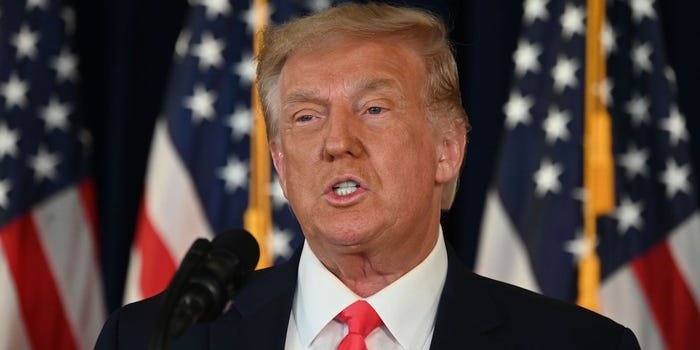
US President Donald Trump has berated critics of his deal with Iran on Thursday, calling those who accused him of offering concessions to end the war “fools” ahead of negotiations in Switzerland on implementing the deal.
Oil prices nosedived after Trump and his Iranian counterpart separately signed their accord to end the Middle East war, with the Strait of Hormuz to reopen but two months of negotiations lying ahead.
Following uncertainty over whether the pact struck earlier this week would be formally signed, Trump signed it in thick black ink at a candlelit supper with French President Emmanuel Macron on Wednesday at the Palace of Versailles outside Paris.
Macron, who had previously hosted the G7 conference, cheered “bravo” as Trump signed inside the palace that housed the signing of the Treaty of Versailles.
“These fools, who think I haven’t been tough enough on Iran when the stock market just hit A RECORD HIGH and oil prices are ‘tumbling’ down, are either jealous, bad people, or stupid,” Trump posted on social media hours after signing the deal.
Iranian President Masoud Pezeshkian also signed the deal, Iranian Foreign Ministry spokesman Esmaeil Baqaei said, adding that “now it is time to test the implementation of the agreement.”
The price of crude fell more than three percent Thursday, extending the losses incurred since news of the deal surfaced at the weekend.
The pact should bring an end to the present US-Israeli conflict with the Islamic Republic, which saw five weeks of all-out war until a ceasefire in early April and resulted in shipping being substantially constrained in the Strait of Hormuz, causing a surge in energy prices.
Prime Minister Shehbaz Sharif of Pakistan, who assisted in mediating the agreement, stated that it “shall enter into force with immediate effect” and that Iran “will instantly reopen the Strait of Hormuz.” “He also signed the pact.
A two-month negotiating session has now begun, with all eyes on the reopening of Hormuz and whether progress can be achieved in discussions over Iran’s nuclear program, which Washington has long suspected of concealing hidden bomb-making ambitions.
Macron applauded the deal “which allows for peace, the reopening of the Strait of Hormuz without tolls, and 60 days to conclude an agreement on nuclear, ballistic, and regional activities.”
The next steps remained unclear, with the agreement originally scheduled to be signed on Friday at an exclusive mountain-top resort in Switzerland by Iran’s principal negotiator and parliament speaker, Mohammad Bagher Ghalibaf, and US Vice President JD Vance.
Baqaei stated that an in-person ceremony was no longer necessary. However, Sharif stated that an official ceremony will be held in Switzerland on Friday, following which technical talks will begin.
According to the document, Washington agrees to quickly lift oil sanctions that are crushing Iran’s economy.
Furthermore, once a definitive agreement on Iran’s nuclear program is reached, the US will assist the disbursement of a $300 billion reconstruction fund sponsored by regional countries, according to the plan.
UN atomic agency chief Rafael Grossi told reporters in Geneva that the organization was ready to begin identifying the “concrete steps” required to achieve a US-Iran agreement.
US officials also stated that Iran will dilute its enriched uranium stocks, presumably through “down-blending on site” under the observation of the UN inspector.
The accord made no mention of Iran’s ballistic missile program, despite Israel’s long-standing demand for its removal.
“Iranian missiles are only for firing, not for negotiations. Iran’s defense capability will not be discussed in any way, in any process, or with any party,” Baqaei said.
Hardliners in Iran have criticized the conflict as a “imposed war” and compared it to the 1980-1988 conflict with Saddam Hussein’s Iraq.
However, Ghalibaf argued that the deal was a US “failure,” while Pezeshkian called it “historic.”
Trump’s decision to end the war, which killed 13 US service members and used a significant portion of US ammunition stockpiles, has unnerved some of his allies at home.
However, US Senator Bill Cassidy of Trump’s Republican Party called it the “worst foreign policy blunder in decades.”
“Iran’s nuclear ambitions were not curbed, and they have learned that threatening the Strait of Hormuz works,” he said.
Even Fox News, the generally pro-Trump news channel, cited critics who claimed the pact provided Iran with “huge financial benefits” without necessitating the dismantling of its nuclear program.
And, while the agreement states that Lebanon should be included, it is uncertain whether the war there would be handled within the next 60 days.
On March 2, Hezbollah fired missiles toward Israel in support of Iran, drawing Lebanon into the battle. Israel replied by conducting a huge air and ground campaign.
While violence in Lebanon has decreased since the announcement of the agreement, an Israeli drone attack in south Lebanon killed one person on Thursday, according to Lebanese official media.