



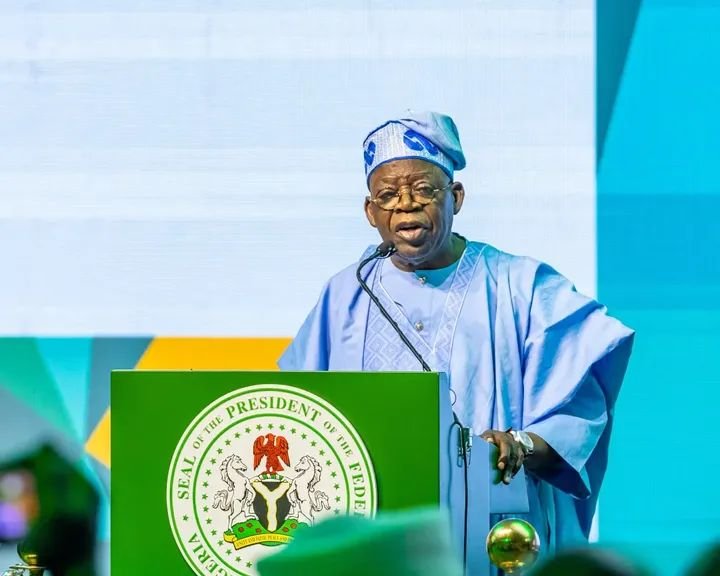
President Bola Tinubu may secure re-election in the 2027 presidential election despite widespread public dissatisfaction with his administration, according to The Economist.
In a report published on October 1, Nigeria’s Independence Day, the British publication examined the factors that could shape the 2027 contest, including Nigeria’s security crisis, the impact of economic reforms, opposition fragmentation, religion and voter turnout.
The Economist noted that Tinubu’s apparent confidence was surprising given the challenges facing his administration.
“On the face of it, Mr Tinubu’s cool is surprising,” the newspaper wrote.
Complicated Electoral Dynamics
According to The Economist, Tinubu’s confidence may have more to do with Nigeria’s electoral dynamics than widespread satisfaction with his government.
The publication said incumbents have historically benefited from access to ruling-party structures and financial resources during Nigerian elections.
“Incumbents, with access to the ruling-party machinery and plentiful cash to dole out goodies, have tended to have an advantage in recent Nigerian elections,” it stated.
The Economist also highlighted the fragmentation of the opposition.
Atiku Abubakar and Peter Obi, identified in the report as leading opposition figures, are contesting under the African Democratic Congress (ADC) and Nigeria Democratic Congress (NDC), respectively.
The publication argued that their failure to form a joint ticket could make it harder for opposition votes to consolidate behind one candidate.
It also examined the 2023 election, noting that a united opposition vote could have altered the outcome.
Atiku contested the 2023 election under the Peoples Democratic Party (PDP), while Obi ran on the Labour Party (LP) platform. The two politicians had previously been allies in the PDP.
Quoting Joachim MacEbong of Control Risks, The Economist said: “Because it’s not a united ticket, that anti-APC vote is not coalesced into a single vote.”
Religion And Political Cynicism
Religion was also identified as a factor that could influence voting patterns.
The Economist noted that Tinubu and Vice-President Kashim Shettima are both Muslims and said their religious identity could resonate with some voters in northern Nigeria, which has the largest concentration of registered voters.
The publication also discussed how religious identity could affect Obi’s support.
“Even voters who like Mr. Obi may rule him out because he is a Catholic; the fact that he has a Muslim running mate may not be enough,” it stated.
The Economist further identified political cynicism among some voters as a potentially important factor.
It cited MacEbong as saying that some voters in northern communities may not assess Tinubu’s administration solely on its record because they have become accustomed to poor public services.
“Many people are living where there has been no real security, no real health care, no real schools. Over time, people’s expectations get lower and lower,” MacEbong was quoted as saying.
The publication cited the example of a woman in Maiduguri who said she planned to vote for Tinubu as a “thank you” for medicine she received at a government hospital.
Voter Turnout And Identity Politics
The Economist also linked Tinubu’s prospects to voter turnout, particularly in areas affected by insecurity.
It noted that while some voters may be dissatisfied with the government, that dissatisfaction may not necessarily translate into votes against the incumbent.
“As long as the security crisis remains unresolved and economic growth, which is expected to hit 4.1% this year, does not translate into concrete improvements in Nigerians’ daily lives, many voters will remain disappointed. Yet few will use the ballot box to express their disappointment,” the publication added.
The paper also examined identity politics in parts of southern Nigeria, particularly Lagos, where Tinubu has strong political roots.
It quoted the publication as saying that some voters could “swallow whatever bad feelings they have about their day-to-day struggles and vote for their ‘son’.”
The Economist concluded its analysis by linking Tinubu’s apparent confidence to these political dynamics, writing: “No wonder Mr Tinubu feels safe enough to take extended holidays in Paris.”