




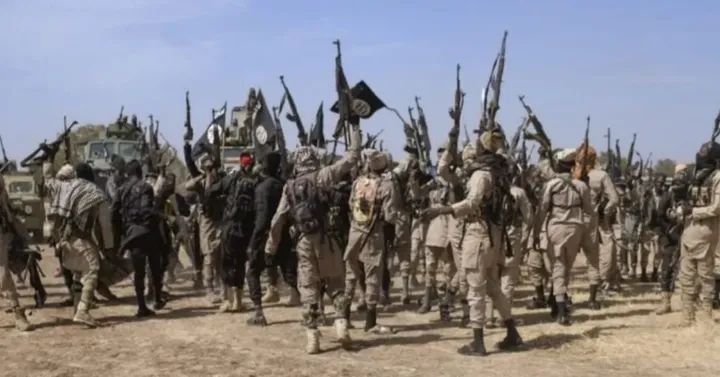
Many of the terrorists dislodged from Zamfara and Sokoto states have been relocating to the South-East and South-South regions, security and intelligence sources reveal.
The terrorists, according to the sources, are utilising interconnected forest corridors and riverine routes stretching through Niger, Kogi, and Anambra states to escape military pressure in the North.
According to reports, including a security chief, a retired army general, and a Department of State Services officer, the terrorists were travelling through Niger and Kogi states into Anambra and then into Abia and Imo states, while some have proceeded further south.
“These terrorists started moving from Zamfara; they went through the bushes and forests and might have ended up in other states, including Imo and Abia. Some are even in Ogun State,” a security chief disclosed.
“The Ansaru group, Sadiku, Masua and other groups are in Niger, Kwara, and some parts of the South-West. Very soon, we are going to get them. They have been degraded,” the source added.
A retired army general explained how the terrorists are making their way to the southern areas, stating that the insurgents rely primarily on the Niger River corridor in the eastern portion of Kogi State, notably in Igala land, to cross into Anambra State and then to Imo and Abia.
“The connecting links for these terrorists are the forests that network the North (Zamfara–Benue–Niger–Kogi) with the South-East and South-West: Anambra, Ekiti and Ondo states, to be specific,” the retired general said.
He described Kogi as the intersection point for terrorist movements, claiming that the state had served as a hub for logistics and coordination.
“The terrorists are guided by cattle paths in the bush; I am not saying they are herders because herders are also victims of banditry or terrorism. The bandits kill them and rustle their cattle. That is why you see herders moving with their cattle on major roads,” he said.
“So, they use the cattle routes in the forests because there is transhumance. The intersecting points are Kogi and Kwara. They connect to the South from those states through the Oyo National Park and the riverine and forested terrain along the Niger River in Igalamela-Odolu and Ofu Local Government Areas of Kogi.”
He added a political dimension to the security situation in the area, saying, “Kogi is central to their planning. It is like the centre point, maybe for convergence and strategy.
“Unfortunately, a former Kogi governor, who introduced violence in that area and armed some criminals, disbanded those boys. But the guns were not recovered. Some of those boys are now with the terror groups.
“That is why if some Boko Haram members are arrested today, you see a lot of boys from Kogi, particularly Ebira and the Igala area.”
According to a DSS officer who confirmed the development to the press, the Niger forests’ pathways connect a vast network of states, including Niger, Kwara, Kogi, Oyo, Ondo, and Ekiti.
“They have a command center in Kogi, where they train and strategise. There is a forest in Kogi that links the Ikole/Ijero forest and the Ogbese Forest Reserve in Ekiti State. That forest also links Ose and Ikare in Ondo State. They gain access to Edo State through that route,” the officer said.
Findings showed that Ose shares a direct boundary with the Owan area of Edo State, which provides one of the most direct South-South linkages from the corridor.
Further findings also disclosed that the Owerre-Ezukala/Ogbunike/Awka-Orlu axis between Anambra and Imo states features dense forests, deep valleys and difficult terrain, making it a viable route for fleeing terrorists.
Similarly, the Ihiala-Orlu-Okigwe corridor, which connects Anambra and Imo, has abundant vegetation and bush pathways that give natural shelter.
The Umunneochi-Isuikwuato axis in Abia State, located near the Imo and Anambra borders, is distinguished by mountainous topography and forested zones that connect directly to the larger South-East forest belt.
According to a DSS source, the tactical migration into Edo State via the Ondo-Ose axis has already prompted defensive government responses.
“Since the December 2025 US strikes on terrorists in Sokoto, the insurgents have spread across the country. They are already in Edo State; that was why the government had to shut schools,” the officer said.
On Wednesday, the Edo State Government ordered the immediate closure of three secondary schools in the Akoko-Edo Local Government Area in response to intelligence indications of a planned kidnapping attack.
The affected schools are Ososo Grammar School, Ososo Comprehensive High School, and Makeke Secondary School.
The state administration stated that the decision was based on security advisories from competent agencies that warned of credible threats to the safety of students, teachers, and residents in Akoko-Edo.
Beyond the difference in geography, the intelligence officer revealed that the terrorists had fundamentally changed their operational strategy from kidnapping for ransom to seeking high-profile prisoner swaps.
“Their target is the mass abduction of schoolchildren and other people. They want to use that to negotiate with the government for the release of their commanders who are either in prison or in the custody of security agencies.
“The same group that kidnapped the Oyo schoolchildren and teachers is responsible for the kidnappings in Niger, Ekiti and Kwara. In the past, the government might have negotiated with the terrorists and facilitated the release of some of their commanders in exchange for the abducted victims.”
However, the source noted that federal strategy had stiffened, saying, “The government is not going to bow to pressure on the Oyo matter because Nigeria and the US have signed a deal not to negotiate with terrorists. We are also receiving foreign support for the rescue operation. We are closing in on the terrorists, and we will rescue those abducted,” he added.
Meanwhile, Agunechemba, the Anambra State security agency, reported seeing suspected bandits, kidnappers, and other armed criminal organisations operating in woods, riverine areas, and border communities around the state.
The organisation, however, stated that it had no intelligence indicating that terrorists displaced from the north of the country were crossing through Anambra State into Abia and Imo states.
Nweke Nweke, Agunechemba’s spokesperson, told newsmen that the outfit discovered arms stockpiles during its operations.
“Agunechemba has encountered bandits in various locations, including riverbanks, farmlands and other secluded areas across the state. I can assure you that we are maintaining vigilance across the state against any unforeseen development,” he said.
Nweke went on to say that the organisation used strategic roadblocks, intelligence collection, and community-based monitoring to prevent terrorists and armed bandits from infiltrating the area.
According to him, the steps include coordinated military-police-DSS operations, as well as targeted patrols along major routes and border settlements.
“It is important to note that we are new to policing, but we will continue to collaborate with all federal security agencies to guarantee peace across the state,” he added.