





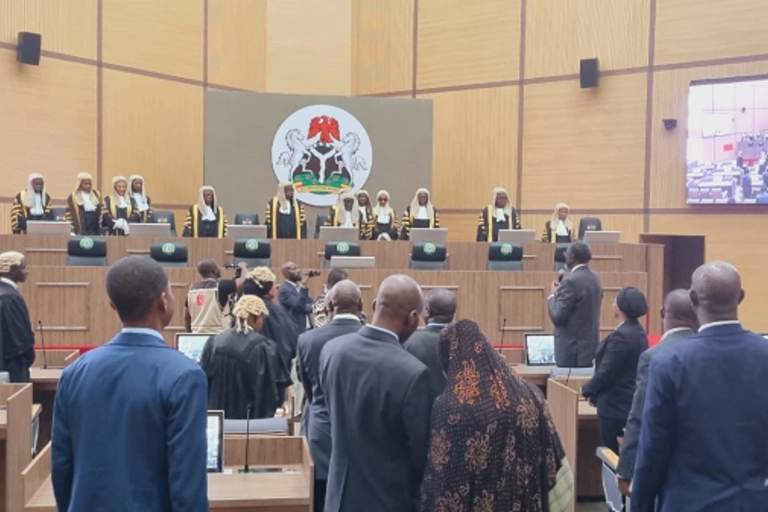
The Supreme Court has reserved judgment in an appeal by the Independent National Electoral Commission (INEC) challenging a Court of Appeal decision that voided key provisions of the Electoral Act 2026 on political party membership registers and candidate nomination.
A seven-member panel of the apex court, led by Justice Adamu Jauro, reserved judgment on Wednesday after hearing arguments from the parties in the appeal marked SC/CR/495/2026.
“This matter is now reserved for judgment, at a date to be communicated to the parties,” Justice Jauro said.
INEC is the appellant, while the Zenith Labour Party (ZLP) is the respondent.
How the case started
The dispute began when ZLP filed a suit at the Federal High Court in Abuja challenging provisions of the Electoral Act 2026.
The party argued that the provisions interfered with the constitutional powers of political parties and were inconsistent with the 1999 Constitution.
The Federal High Court, presided over by Justice Mohammed Umar, dismissed the suit on May 5, 2026.
ZLP subsequently appealed to the Court of Appeal in Abuja in a case marked CA/ABJ/CV/750/2026.
On July 16, 2026, the Court of Appeal allowed the appeal in part and declared Sections 77(5), 77(6), 77(7) and 84(2) of the Electoral Act unconstitutional.
What the disputed provisions cover
Sections 77(5), 77(6) and 77(7) deal with political party membership registers.
Under the provisions, only members listed in the register submitted to INEC could participate in party primaries, congresses and conventions. Parties were also barred from using another register, while failure to submit the register within the required period could prevent a party from fielding candidates.
Section 84(2) provides that political parties should nominate candidates through direct primaries or consensus.
ZLP argued that the provisions amounted to unconstitutional interference in the internal affairs of political parties, relying, among other provisions, on Sections 221 and 222 of the Constitution.
Supreme Court to settle dispute
INEC subsequently appealed the Court of Appeal judgment to the Supreme Court, asking the apex court to determine whether the lower court was right to void the disputed provisions.
The Supreme Court’s eventual judgment will determine the legal status of the provisions and could affect how political parties manage membership registers and conduct candidate-selection processes ahead of the 2027 general elections.


