

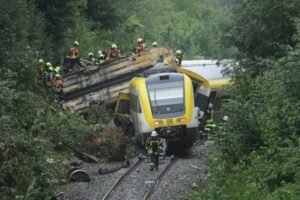



Spain has begun three days of mourning following the deaths of at least 68 people and injuries to dozens more in one of the worst rail disasters in Europe’s modern history.
Emergency crews labored through the night beneath powerful floodlights, cutting open metal carriages as they searched for victims, with many of those killed in the crash yet to be identified.
Officials are looking into what caused the disaster, which happened when a train travelling from Madrid to Seville crashed into a stationary train on Wednesday morning.
Prime Minister Pedro Sánchez said the “whole of Spain is grieving,” adding that “lives have been shattered, families have been torn apart, and the pain is immense.”
According to Spain’s interior ministry, hundreds of personnel have been sent to the disaster site to help with recovery efforts, with drones and helicopters used to locate victims and clear rubble.
The stationary train, operated by private rail company Iryo, was carrying 147 passengers and had stopped on the tracks due to a computer failure, according to Spain’s transport minister Óscar Puente.
He said that when a system failure occurs, a 24-hour control center in Madrid takes over, but it had made an “inexplicable” decision to tell the trains to move again, with no speed restrictions.
Audio recordings between train controllers in Madrid and the drivers appear to show that one high-speed train was cleared to move even though another train ahead had stalled.
Iryo said its train was “struck from behind” by another train, operated by Spain’s state-owned railway company Renfe, which was carrying 397 passengers. The force of the crash sent several carriages down an embankment.
Witnesses described seeing people crying and bleeding, passengers trapped in their seats, and smoke filling the carriages, one of which caught fire.
Sánchez said it was “unacceptable” that Spain had suffered two serious rail disasters this year, after a high-speed crash killed 46 people near Córdoba in January. It happened on the same line as Wednesday’s accident, but much further south.
Most political parties suspended campaigning for upcoming elections after the incident.
The far-right party Vox was the exception. Its leader, Santiago Abascal, said his party would not take part in what he described as attempts to “use mourning to silence criticism” of the country’s rail infrastructure.