



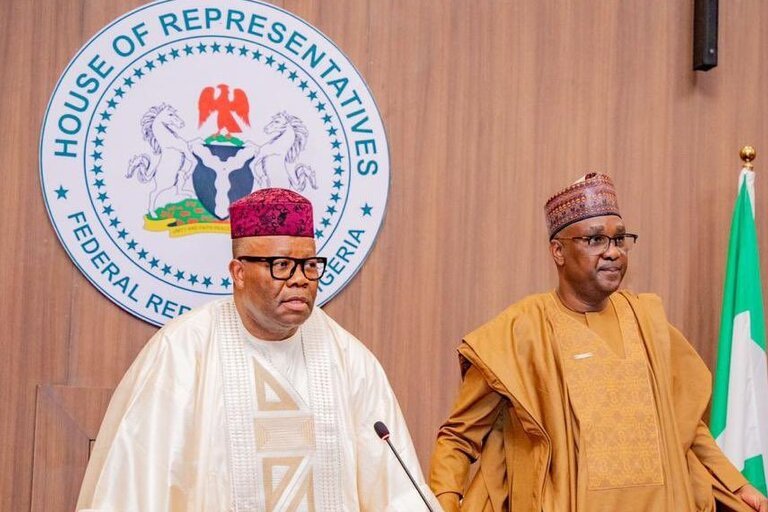
The Socio-Economic Rights and Accountability Project (SERAP) has called on Senate President Godswill Akpabio and Speaker of the House of Representatives Tajudeen Abbas to immediately refer allegations involving the suspected diversion of more than ₦6.3 billion in constituency project funds to Nigeria’s anti-corruption agencies for investigation.
In a letter dated 27 June 2026 and signed by its Deputy Director, Kolawole Oluwadare, the organisation urged the National Assembly leadership to ensure that anyone found responsible is prosecuted where sufficient evidence exists. SERAP also demanded that any diverted or unaccounted public funds be recovered and returned to the national treasury.
The organisation further requested the public disclosure of contractors and companies that received constituency project funds but allegedly failed to execute the projects, including details of their shareholders and beneficial owners.
According to SERAP, the allegations are contained in the 2022 Annual Report of the Auditor-General of the Federation, published on 9 September 2025.
The group said the allegations suggest serious violations of public trust, the Nigerian Constitution and international anti-corruption standards, warning that corruption in constituency projects undermines economic development, weakens public services and erodes confidence in government institutions.
SERAP argued that the National Assembly must demonstrate leadership in tackling corruption by investigating allegations involving projects approved by lawmakers as part of its oversight responsibilities.
The organisation gave the National Assembly seven days to act, warning that it would pursue legal action if its demands were ignored.
Agencies named in the audit
SERAP highlighted findings involving several federal ministries, departments and agencies, including; Environmental Health Registration Council of Nigeria. Federal College of Animal Health and Production Technology, Vom. Federal Polytechnic Ukana. National Agency for the Prohibition of Trafficking in Persons. National Institute of Legislative and Democratic Studies.
The Auditor-General reportedly identified multiple cases involving payments into private bank accounts, procurement irregularities, undocumented expenditures, inflated contracts, contracts allegedly awarded without due process, payments for projects that were not executed, and failures to properly account for public funds.
Among the findings cited by SERAP were allegations that millions of naira were paid into private accounts, contracts worth hundreds of millions of naira were awarded without adequate documentation, contractors received payments despite allegedly failing to execute projects, and several procurement processes did not comply with legal requirements.
SERAP also pointed to findings that NILDS failed to submit audited financial statements covering 2012 to 2022, did not remit more than ₦15 million in stamp duties, and spent ₦1.6 million without proper authorisation.
The organisation maintained that corruption disproportionately affects poor and vulnerable Nigerians by reducing access to quality healthcare, education and other essential public services.
SERAP argued that the allegations, if established, would amount to breaches of the Fiscal Responsibility Act 2007 and the Public Procurement Act 2007, as well as Section 15(5) of the 1999 Constitution, which requires public institutions to eliminate corruption and abuse of power.
The rights group said it expects the leadership of the National Assembly to act swiftly in the public interest by ensuring a transparent investigation and accountability for any misuse of constituency project funds.