


Ola Oresanya, Ogun Commissioner for Environment, says recurring gas leak incidents affecting schools in Ijebu-Ode may be linked to geological fractures beneath the town.
Speaking on Friday during Morning Brief, a programme on Channels Television, Oresanya said investigations conducted by the state government indicate that the affected schools are situated along the same fault line in the Earth’s crust.
The commissioner said the state initially suspected industrial activity or sabotage when the first incident occurred about two months ago but noted that investigations have gradually narrowed the source to underground geological formations.
“The schools affected are all sitting on the same fracture from the Earth’s crust,” he said.
“We eventually found out that the series of schools are linked. They are all on the same fault line from the Earth’s crust.
“Ijebu-Ode is having a mixture of sedimentary and basement rocks, and we have fractures on the ground. Those schools were lying on the same fracture.”
According to Oresanya, monitoring devices installed after the first incident detected methane concentrations of up to 15,000 parts per million (ppm) during the second occurrence, prompting further investigations into the source of the emissions.
He said authorities considered whether the methane was coming from gas pipelines, mining activities, sabotage, or natural underground sources before concluding that the emissions were likely emerging through geological fractures.
The commissioner said drilling and soil sampling exercises are ongoing to determine whether the gas releases are natural occurrences or triggered by human activities such as quarrying or mining.
“We now know this is coming from the Earth’s crust. It is not an artificial thing,” he said.
Oresanya added that Ijebu-Ode lies along a fault system connected to geological structures extending from the Atlantic region.
The commissioner said the state government had ruled out nearby gas pipelines as the source of the emissions because the nearest pipeline is about five kilometres away from the affected schools.
“Ijebu-Ode sits on the southwest fault line that comes from the Atlantic. That’s why when we had tremors in Nigeria between 1984 and 1985, Ijebu-Ode and parts of Oyo felt them because they are sitting on that fault line,” he said.
“If methane was travelling that distance at the concentrations we recorded, people much closer to the pipeline would have been affected first.”
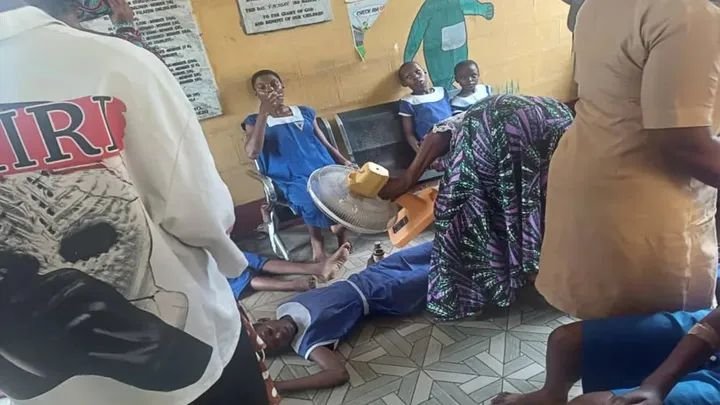
The latest incident occurred on Wednesday when students and staff of Our Lady of Apostles Secondary School were hospitalised after inhaling a pungent gas suspected to be methane. It was the third such occurrence in the community within two months.
On April 1, at least 30 students at the same school were hospitalised after a suspected gas leak caused breathing difficulties among students and teachers. Investigators initially suspected fumes from nearby bushes in the area.