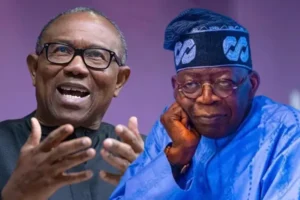
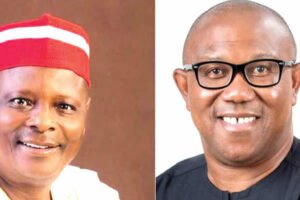


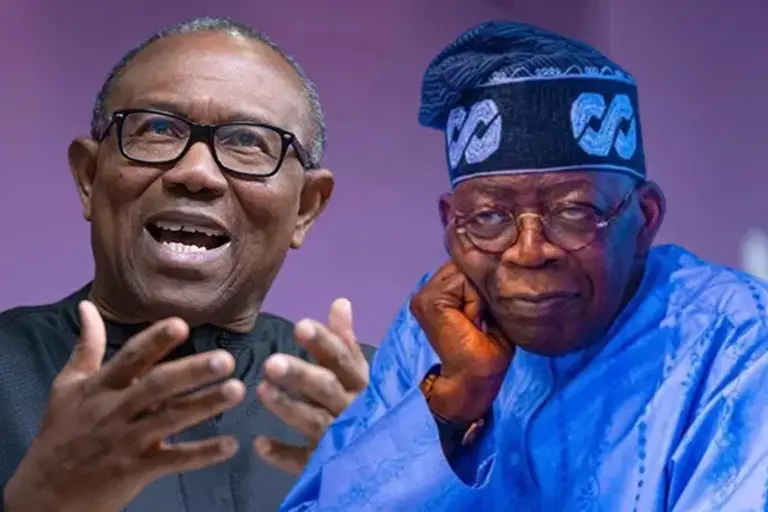
Presidential candidate of the Nigeria Democratic Congress (NDC), Peter Obi, has accused President Bola Tinubu’s administration of borrowing more than all previous Nigerian governments combined, alleging that the loans have not translated into corresponding development.
Obi said his proposed administration, with Senator Rabiu Kwankwaso as vice-presidential candidate, would prioritise productive investments and ensure that borrowed funds deliver measurable economic benefits.
The former Anambra State governor made the remarks during a town hall meeting with residents of Abia State at the Primetime Events Centre in Aba.
He also criticised Tinubu’s handling of the economy, accusing his administration of failing to fulfil campaign promises and implementing policies that had worsened economic hardship across the country.
Obi called on Nigerians to vote out the Tinubu administration in the 2027 presidential election, insisting that the country needed a change in leadership.
His visit to Aba followed a street engagement with residents. His wife, Margaret Obi, and Senator Nkechi Nwaogu, Abia State coordinator of the Obi/Kwankwaso Presidential Campaign Council, accompanied him.
Residents who gathered to welcome the presidential candidate chanted slogans demanding Tinubu’s departure, the restoration of fuel subsidy and an end to hunger and economic hardship.
Obi criticises Tinubu’s borrowing and electricity record
Speaking on the country’s leadership, Obi argued that the presidency required energy and should not become a retirement home for former public office holders.
“The presidency requires energy; it is not a retirement home. We are tired of Tinubu’s government. It deserves to be voted out in 2027 for the emergence of the Nigeria we desire,” he said.
He identified the power sector as one of the areas where he believed the Tinubu administration had fallen short, promising that his government would generate, transmit and distribute at least 10,000 megawatts of electricity.
The NDC candidate also pledged that loans obtained under his proposed administration would be channelled into projects capable of delivering visible economic benefits.
Recalling his recent visit to Minna, Niger State, Obi highlighted Nigeria’s historical unity, noting that nationalist leaders Nnamdi Azikiwe and Chukwuemeka Odumegwu Ojukwu were born in Zungeru.
He promised to reunite the country and create opportunities for Nigerians regardless of their backgrounds.
“We are going to reunite Nigeria. The Nigeria we want is one where a child of nobody can become somebody. Tinubu has borrowed more money than all previous governments before him combined, and has nothing to show for it on the ground.
“Kwankwaso and I want to form a government that will not give you excuses. We will bring prosperity and production back to Nigeria. We will move this country from consumption to production,” he said.
Peter Obi promises to tackle poverty, unemployment
Obi also pledged to tackle corruption, insisting that public resources would be deployed for the benefit of Nigerians.
He cited the Kainji Dam as an example of how previous governments had utilised borrowed funds to execute major infrastructure projects, contrasting it with what he described as the absence of visible results from recent borrowing.
The former governor claimed that the number of Nigerians living in poverty had increased from 87 million when Tinubu assumed office to more than 140 million.
He further alleged that poverty and youth unemployment had worsened, calling for greater investment in education, healthcare, agriculture and infrastructure.
On economic development, Obi promised to transform Aba, Abia State’s commercial capital, into an export hub within a few years of assuming office.
He also pledged to strengthen commercial connections between Aba and neighbouring Port Harcourt, Rivers State, to expand economic opportunities.
Addressing insecurity, he vowed that an administration led by him and Kwankwaso would take decisive action against kidnappers and other criminals.
“We cannot be in government while schoolchildren are being kidnapped and others taken into the bush. We will go into those bushes and rescue them,” he said.
Nwaogu commends residents’ turnout
Meanwhile, Nwaogu, the Abia coordinator of Obi’s campaign council and NDC senatorial candidate for Abia Central in the 2027 elections, described the visit as successful.
She thanked residents for their turnout and support, adding that Obi would return to the state for his formal campaign.
“We sincerely appreciate the good people of Abia State for the massive turnout, warm reception, solidarity and overwhelming show of support.
“We also specially appreciate the wife of our presidential candidate, Mrs Margaret Obi, for her presence and participation. Together, we are building a new Nigeria founded on good governance, accountability and shared prosperity,” Nwaogu said.
Background: Presidency disputes claims about Tinubu’s borrowing
The Presidency has previously disputed claims that Tinubu’s administration borrowed substantially more than previous governments, arguing that the increase in Nigeria’s naira-denominated debt partly reflects exchange-rate depreciation and the formal recognition of inherited obligations.
In November 2026, the Presidency’s Special Assistant on Social Media, Dada Olusegun, said Nigeria’s public debt increased from approximately $113.4 billion in June 2023 to $120.9 billion by June 2026.
He argued that the naira value of the debt had risen significantly partly because of currency devaluation and the securitisation of inherited Central Bank Ways and Means advances.
The Debt Management Office figures cited in the rebuttal showed that Nigeria’s public debt rose from approximately ₦87.38 trillion in June 2023 to ₦166.79 trillion in June 2026.
Meanwhile, Tinubu had requested fresh National Assembly approval for a $7.7 billion external borrowing plan to partly finance the 2026 budget deficit after withdrawing an earlier request involving $20.52 billion and €1.045 billion.
The growing debt burden and the government’s ability to translate borrowed funds into economic development remain subjects of political debate.