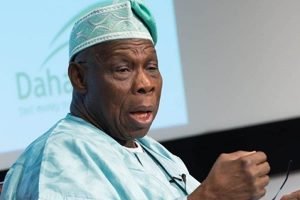




Former President Olusegun Obasanjo has urged immediate steps to tackle Nigeria’s worsening insecurity, unemployment and poverty, cautioning that failures in leadership are pushing citizens to look for better prospects abroad, frequently via risky migration routes.
Obasanjo made the remarks on Saturday at a panel discussion titled “Lest We Forget,” held during the Creative Africa Nexus Weekend 2026, an event organized by the African Export-Import Bank in Lagos State.
The former president, who looked back on Nigeria’s security situation since independence, stated that the country needs to face the governance failures behind shrinking safety and economic opportunities.
“We just have to do what we should do to provide job opportunities, to stem the tide of impunity, to stem the tide of poverty, to stem the tide of kidnapping and insecurity,” he said.
Obasanjo recalled that he returned to Nigeria in 1959 after finishing his military training in Britain, noting that he was able to travel freely throughout the country without fear of attacks or kidnapping.
“I came back to this country in 1959 after I was commissioned as an officer in Britain. And I could go anywhere; I was posted to the North; I could go anywhere in the North, alone, by day or by night,” he said.
Drawing a contrast between that experience and the current security situation, he questioned how Nigeria had deteriorated to the point where citizens could no longer travel safely across several parts of the country.
“Now, if you can’t do that, what has gone wrong? We have to correct what has gone wrong,” he stated.
He argued that unemployment, especially among university graduates, had become a major source of economic desperation, making it hard to discourage young Africans from leaving their countries in search of opportunities.
According to him, governments cannot keep producing graduates without creating enough employment opportunities and still expect them to remain economically productive.
Obasanjo recalled an encounter with Nigerians arrested for drug-related offenses, explaining that one of the suspects had blamed his involvement in the illegal trade on the loss of legitimate employment.
He said the encounter showed how economic hardship could push otherwise productive individuals towards desperate decisions, though he stopped short of justifying criminal activities.
Addressing irregular migration, Obasanjo said he had interacted with Africans who tried to reach Europe through the Sahara Desert and the Mediterranean Sea, describing their experiences as distressing.
“I have got those people who have attempted to cross, and the story they told me is pathetic. Some die in the Sahara, some die in the Mediterranean,” he said.
He maintained that improving governance and creating economic opportunities would reduce the pressure on Africans to undertake life-threatening journeys abroad.
“We have to improve our leadership to deliver, and once our leadership delivers, what does any man want in the world?
“But if they have nothing here, they will look for whatever they can get anywhere else, and you can’t blame them,” he said.
Addressing worries regarding corruption, weak governance, and the development hurdles facing Africa, Obasanjo attributed a large share of the blame for the continent’s underdevelopment to its political leaders.
“Africa is not where it should be, and the fact that Africa is not where it should be rests largely on the shoulders of our leaders. It’s as simple as that,” he stated.
The former president also called for greater freedom of movement throughout Africa, revealing that he had held talks with Ghanaian President John Mahama about a proposal to remove visa requirements among roughly 25 African countries.
He clarified that the initiative would begin with countries that already offer visa-on-arrival arrangements, with the prospect of extending the framework throughout the continent.
“These countries should eliminate visas among themselves, about 25 of them, and if they can do it successfully, then maybe in a matter of a few years, the whole of Africa will be able to move,” he said.
Obasanjo also condemned the limited recognition of the African passport and urged African governments to grant automatic citizenship to people of African descent seeking to return to the continent.
“I believe that all African states should have such a policy. That anybody from the diaspora who wants to be a national of any African country should automatically be given,” he said.
Obasanjo likewise urged Africans and people of African descent around the world to unite more closely, emphasizing that past divisions should not stand in the way of working together for shared prosperity.
He insisted that African nations need to reinforce their leadership, broaden economic opportunities, and deepen continental integration in order to tackle the challenges their citizens face.
The session, which also included former Prime Minister of St. Vincent and the Grenadines Dr. Ralph Gonsalves and Jamaican scholar Prof. Paulette Ramsay, looked at African identity, slavery, colonialism, reparations, and the need for closer ties between Africa and its diaspora.
All three speakers demanded reparatory justice for the trans-Atlantic slave trade and colonialism, contending that the historical exploitation of Africans continues to affect the continent’s development, among other things.
Ramsay, author of “Lest We Forget: Slavery, Slave Trade, Colonization, Emancipation and Reparation,” commended Obasanjo for supporting the publication, which brought together scholars, policymakers, and cultural experts to examine Africa’s historical experiences.
She also stated that reparations should extend beyond monetary compensation to include the return of stolen artifacts, stronger protection of African cultural heritage, and an end to the continuing exploitation of the continent’s natural resources.
“We must not remember with bitterness. We must teach younger generations that we remember the horrible things that were done, but we survived, and that’s the best part of the African story, that we survived,” she said.