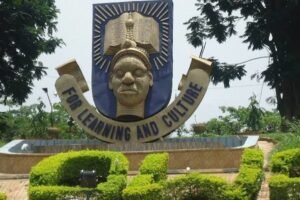




Students of Obafemi Awolowo University, OAU, Ile-Ife, Osun State, have declared a 72-hour lecture boycott in protest against what they described as the “inadequate and poorly implemented” campus transportation system linked to vehicles donated by the First Lady of Nigeria.
The boycott, slated to last from Tuesday, April 14 to Thursday, April 16, 2026, was declared in a resolution issued by the OAU Students’ Union Government following a congress on April 9 and subsequent joint sessions of its leadership structures.
In a statement co-signed by the OAU SUG President Adelani David and Secretary-General Habeeb Oke, the union claimed the decision came after weeks of growing irritation with mobility issues on campus, which it said had hampered academic programs and ordinary student movements.
“The union shall embark on a total 72-hour lecture boycott starting from Tuesday, 14th April 2026, to Thursday, 16th April 2026. All academic activities are to be boycotted throughout this period,” the statement read.
The students claimed that the new transportation arrangement had made commute conditions worse across campus, citing a lack of vehicles, overcrowding, excessive wait times, and poor route coverage.
According to the union, the situation has been especially challenging for students living off-campus, who now have few and expensive options outside of the university’s jurisdiction.
They also stated that numerous meetings with university administration had not resulted in instant relief, despite assurances that the system was in a “teething phase.”
Among their demands are more vehicles to service the roughly 35,000 students on campus, the resumption of the former transportation system while it is improved, and complete consultation with student leaders prior to any further policy changes.
The union also advocated for a more inclusive and hybrid transportation plan that reflects the realities of student mobility across campus and into neighboring communities.
It warned that if its issues were not addressed within the 72-hour period, it would escalate to a larger protest.
“The leadership shall review the situation at the end of the 72-hour boycott. Further actions such as a possible mass protest/march shall be considered if the management fails to address the demands satisfactorily within this period,” it said.
The achievement comes after Nigeria’s First Lady, Oluremi Tinubu, donated 80 compressed natural gas buses and tricycles to the university with the goal of boosting campus transportation and alleviating mobility difficulties for students and staff.
The university administration then restricted intra-campus travel to donated automobiles, a decision that was initially lauded as a modernization initiative but which students claim has produced unexpected operational issues.
In a previous statement, the Students’ Union acknowledged the intervention but stated that implementation deficiencies had resulted in long lines, delays, and limited fleet availability, particularly during peak hours.
The union also expressed worry over the removal of commercial transport carriers who formerly served areas of the campus, claiming that this had further limited mobility alternatives.
During meetings with management, officials reportedly defined the current phase as a transitional “teething period” and promised that more buses would be added within months to increase efficiency.
Despite these assurances, students believe that conditions remain harsh, motivating the decision to launch the boycott as a pressure tactic.