



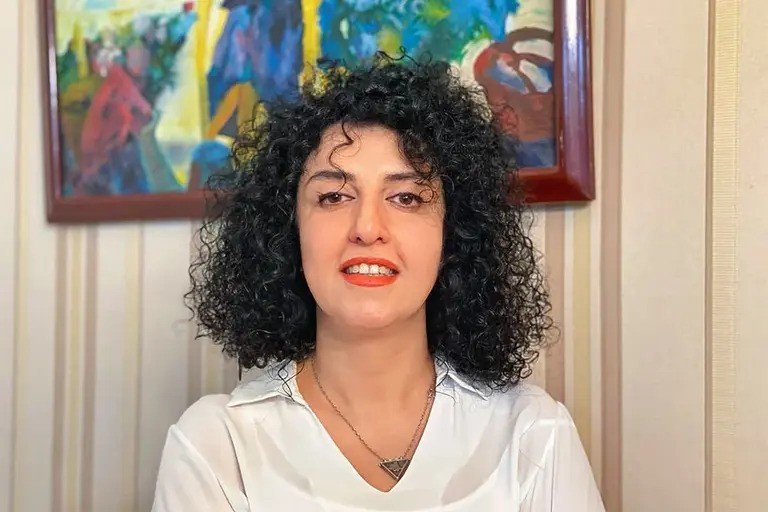
Iranian security forces on Friday “brutally” apprehended Narges Mohammadi, the 2023 Nobel Peace Prize laureate, along with at least eight activists during a memorial event for a lawyer who passed away earlier this month, according to her supporters.
Mohammadi, given temporary leave from prison in December 2024, was apprehended with eight other activists during the ceremony for lawyer Khosrow Alikordi, who was discovered dead in his office last week, her foundation stated on X.
Among those detained at the ceremony in the eastern city of Mashhad was Mohammadi’s fellow notable activist Sepideh Gholian, who had been imprisoned with her in Tehran’s Evin prison.
Speaking on X, Mohammadi’s husband, Taghi Rahmani, who is based in Paris, also confirmed the arrests.
The Hengaw rights organization reported that the activists were “violently detained and transferred to an undisclosed location.”
“Narges was beaten on the legs, and she was held by her hair and dragged down,” one of her brothers, Hamid Mohammadi, told AFP in Oslo, where he lives.
Alikordi, 45, was an attorney who represented clients in delicate situations, including individuals detained during a crackdown on widespread demonstrations that began in 2022.
His remains were discovered on December 5, leading rights organizations to demand an inquiry into his demise, which the Norway-based NGO Iran Human Rights claimed had “strong evidence of a state killing.”
The Human Rights Activists News Agency (HRANA), located in the US, released a video of Mohammadi, who was not donning the mandatory headscarf for women in public in the Islamic Republic, participating in the event alongside many other supporters of Alikordi.
They reportedly chanted slogans such as “Long live Iran,” “We fight, we die, we accept no humiliation,” and “Death to the dictator” during the ceremony that, in accordance with Islamic custom, commemorated seven days after Alikordi’s passing.
Additional footage aired by Persian-language TV networks based outside Iran depicted Mohammadi standing on a vehicle with a microphone, urging the crowd to chant slogans.
Mohammadi, 53, who was most recently taken into custody in November 2021, has remained largely imprisoned for much of the last ten years.
In 2023, her two twin children accepted the Nobel Prize in Oslo on her behalf, and she hasn’t seen them for 11 years now. Mohammadi announced last month in a statement celebrating the 19th birthday of her twins that she had been permanently prohibited from exiting Iran.
However, she has stayed resolute outside prison, declining to don the headscarf, speaking to international audiences through video calls, and engaging with activists throughout Iran.
She was granted temporary release in December 2024 for health reasons due to lung problems and other complications. However, advocates have cautioned that she may be re-arrested at any moment.
“In the prison, she had lots of complications. Her lungs, her heart—she has had some operations,” said Hamid Mohammadi.
“I’m not worried that she is arrested. She’s been arrested a lot of times, but what worries me most is that they will put a lot of pressure on her physical and psychological condition. And it might lead to again experiencing those complications,” he added.
She received the 2023 Nobel Peace Prize for her twenty-year struggle for human rights in the Islamic republic and firmly supported the protests of 2022-2023 that erupted after the death in custody of Iranian Kurdish woman Mahsa Amini.
Mohammadi has consistently foreseen the collapse of the clerical regime that has governed Iran since the 1979 Islamic revolution.
The clerical leaders were unsettled by the prolonged protest movement advocating for women’s freedom in clothing choices while also presenting broader political requests. It merely diminished under a severe crackdown that was denounced by the global community.
In her birthday message to her twins, she remarked that while Iranian officials “imprint the term ‘permanent’ on our papers, they themselves face each day in dread of the collapse that will surely arrive at the hands of the Iranian people.”