



Nigerians may have to endure some of the inconveniences caused by ongoing road construction as the Federal Government continues its infrastructure projects across the country, President Bola Tinubu’s Special Adviser on Media and Public Communications, Sunday Dare, has said.
Dare made the comment during an interview with Channels Television while responding to concerns over the deteriorating condition of the Benin-Abeokuta Road and the wider state of federal roads.
He described the Benin-Abeokuta Road situation as an isolated case but acknowledged that both the government and contractors have responsibilities to ensure road projects are properly executed.
“Government has a responsibility to identify the roads that need to be fixed. Government has a responsibility to provide the funding, and then the next responsibility goes to the contractors to do what is necessary,” he said.
Dare criticised the contractor handling the affected road, saying the work was not professionally executed despite explanations offered by the contractor.
“The contractor talked about piloting, and what we see in this instance is that whatever piloting he did on the roads was not professionally done, very clearly,” Dare said.
He said the Minister of Works was expected to take punitive action against the contractor.
“We know that the Minister of Works is going to take some punitive action against them, and that will serve as a warning to several other contractors across the length and breadth,” he said.
Why was the contractor awarded the road project?
Dare also faced questions over how a contractor described as technically incompetent secured an important road project.
He explained that contractors are subjected to a procurement process in which they present their qualifications, previous projects and technical proposals.
“You will present your documents, the work you have done. You bring your engineers to articulate what they would do,” he said.
However, he acknowledged that there could be a gap between what contractors present during procurement and their actual performance during project execution.
“Oftentimes you also find a gulf between what is presented at the procurement process and some competencies, and then when it’s translated into practice,” he said.
Dare said the technical requirements and key performance indicators for contractors handling major road projects may need to be reviewed.
“I think what’s important is that perhaps the level of technical competency should be looked at again, vis-à-vis the nature of our roads, and the KPIs for those that would take this contract should be reviewed,” he said.
Dare defends government response
Defending the government’s response to the Benin-Abeokuta Road crisis, Dare pointed to the presence of the Minister of Works, lawmakers and other stakeholders at the site as evidence of a swift response.
“What we saw yesterday was the minister, the National Assembly members, and all the key stakeholders going in there in record time, right on the spot. And I think that’s what good governance is about: responding as quickly and as swiftly as possible, putting the blame where it is, and requesting immediate action,” he said.
On the broader state of federal roads, Dare said Nigerians should not expect every problem to be resolved immediately, arguing that road construction is a progressive process.
“What we expect is a 100% solution, and solutions are progressive,” he said.
He cited the Abuja-Lokoja road as an example, saying he travelled along the route with about 65 journalists four weeks earlier and saw construction work taking place on different sections.
“I’ve travelled on the stretch with about 65 other journalists about four weeks ago, went to Kogi State, and we saw the efforts in Abuja, the Lokoja stretch going down to Okene. Concrete work is being done in different sections, sometimes 70%, and that’s what happens with road construction. You build them in points, and eventually you join them,” he said.
According to Dare, motorists may continue to use older sections of roads while construction proceeds elsewhere.
“So you have stretches in which you have to travel on the old road with vehicles coming in in opposite direction, pending when you can switch to the one that hasn’t been completed,” he said.
He compared road construction to building a house, saying projects cannot be completed all at once.
“The roof, until the roof comes on, the rain will still pour down on you. I think this President Bola Ahmed Tinubu, on top of what’s happening? Absolutely,” he said.
Tinubu government overseeing 320 roads
Dare said the Tinubu administration was overseeing a major road construction programme involving hundreds of roads nationwide.
“We’re talking about the five biggest roads. We’re talking about 320 roads across the length and breadth of our country. A massive infrastructural effort of road construction,” he said.
He added that the administration’s focus extended beyond roads to sectors including oil and gas, education and agriculture.
“This country is vast. Beyond the road construction, there are efforts ongoing in about 90% of the credit sectors, in oil and gas, in education, in agriculture; all of these have the backing and the directives of the president. So it’s not just about road construction alone,” he said.
Dare also defended the Minister of Works, saying he was carrying out responsibilities assigned by the President.
“Why do you have ministers? Why are they assigned? So we see the Minister of Works, assigned by Mr President, doing the necessary work to make sure that he fixes the roads in the country,” he said.
Responding to criticism of the administration’s infrastructure projects, including concerns raised by Senator Babafemi Ojodu over the Ekiti-Ondo Road, Dare said the Minister of Works would respond to the specific issues raised.
He said the government was also working on education, agriculture, social safety nets and local government autonomy.
“What you cannot disagree with is that you have the president and the government, an APC government, that is at work making efforts to meet the challenges facing this country,” he said.
Dare added that implementing the administration’s policies would require time and sufficient scale.
“Again, it’s a question of scalability, and it takes time. We’re just three and a half years down the road,” he said.
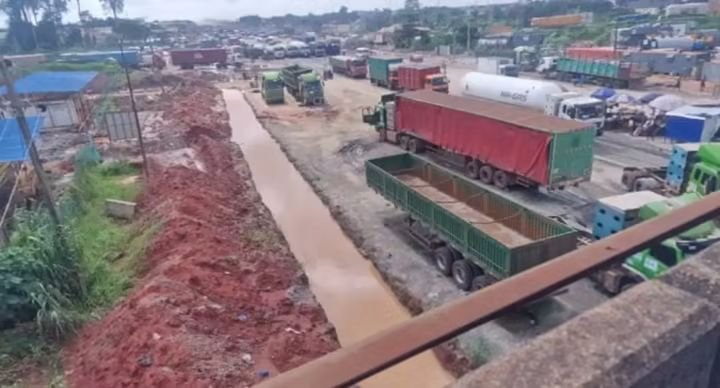
The comments followed an earlier report by on the Benin-Abeokuta Road after the Minister of Works inspected the troubled route alongside members of the National Assembly, the Edo State Governor and other stakeholders.
The inspection came amid complaints from residents and commuters over severe traffic gridlock and prolonged delays on the road.