
Photo: AFP
Nigerian commander Remi Fadairo points to the roiling plume of black smoke blotting the morning horizon in the Niger Delta — the unmistakable sign of an illicit oil refinery.
“Let’s see if we can go eat them for breakfast,” he says with an ominous chuckle.
The 44-year-old colonel, a man with broad shoulders wearing his fatigues tucked into gumboots, is standing in the middle of a destroyed illicit refinery in Kana Rugbana, an area in the swamplands some 20 nautical miles from Port Harcourt.
Fadairo is part of the Joint Task Force Operation Delta Safe, a coalition of Nigerian security forces tasked with protecting the country’s oil and gas infrastructure.
Last year, militant attacks cut oil production to 1.4 million barrels per day in August, triggering Nigeria’s worst economic slump in 25 years.
Following talks with the government, the militants have suspended their sabotage. But Nigerian troops on the ground say the battle isn’t over, it’s just changed.
Today, the military says one of its priorities is to crack down on the illicit refineries that they claim fund the operations of the militants.
“The two are interwoven, if they aren’t doing militancy, they are doing this,” Fadairo tells AFP as he wades through crude-soaked muck.
Despite the site looking like a scrap yard, Fadairo says it actually is being rehabilitated, showing new silver pipes welded to a rusted metal container.
On the ground between iridescent oil puddles lay little sachets of gin, empty packets of instant noodles and cigarette butts left by the bush distillers.
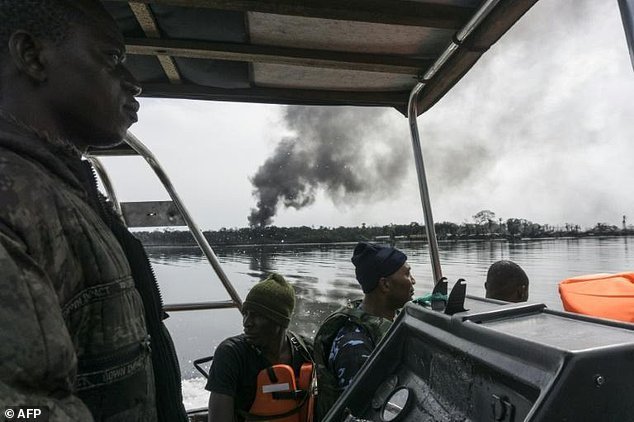
Photo: AFP
“We just destroyed all this but they are back,” says Fadairo. “They are trying to revive it.”
– Mangrove skeletons –
The illicit oil refineries are just one component of oil theft in Nigeria, a mammoth industry estimated to be worth as much as $8 billion a year, according to a 2013 report by Chatham House, a London think-tank.
“The principal security concerns are endemic corruption, which creates economic discontent, breakdown of the rule of law, which allows for criminality to be normalised, and the funding of militancy,” said Ian Ralby, founder of the I.R. Consilium, a security advisory firm.
In the past month, Fadairo’s troops have destroyed more than 10 illicit oil refineries, which process oil stolen from the pipelines of multinational companies, including Shell and Eni, by heating it in car-sized metal containers.
The waste is dumped into the surrounding swamplands, turning what should be a wetland paradise into a monochrome nightmare dominated by the white skeletons of dead mangrove trees.
These artisanal refineries, as they are sometimes called, employ upwards of 50 men each, who work through the night to avoid detection.
They offer a rare job opportunity to thousands of unemployed men in the Niger Delta suffering from extreme poverty.
For militants like the Niger Delta Avengers, who say crude is their birthright, refining represents something bigger – a chance to take back oil profits from corporations and the Nigerian government.
Perhaps recognising that fighting illicit oil refineries is an exercise in futility, as part of the government’s Niger Delta outreach program Vice President Yemi Osinbajo has proposed legalising the “modular refineries”.
“There is a way out of violent agitation, but it is by creating opportunities and the environment where the people in the communities can benefit,” Osinbajo said in early April.
– ‘Wild waters’ –
As an olive-branch to the Niger Delta, Osinbajo’s plan has been welcomed by community leaders. Making it a reality is more complicated.
Too many people, ranging from the refiners to militants to corrupt officials, have got used to enjoying the untaxed spoils of the land.
Any disturbance to the delicate balance in the region may result in violence and, in the worst-case scenario for cash-strapped Nigeria, further disruptions to oil production.
Going into presidential polls in 2019, analysts say the likelihood of more unrest is high, especially once electioneering begins in earnest.
“Rival theft networks can lapse into turf wars and the proceeds from stolen oil could continue to be used to finance election bids,” explains Gillian Parker, a Nigerian analyst at the Control Risks consultancy.
Until then, Nigerian forces will continue playing the cat-and-mouse game in the creeks.
For Fadairo and his team by mid-morning they have arrived in gunboats at the site of another illicit oil refinery.
Landing on a sandy shore gently lapped by oily waves, the troops spot a group of men fleeing from the bush and disappearing into the creeks in a speed boat.
“Sometimes they can out-manoeuvre us,” says an officer, squinting his eyes as the men make their getaway. “The water is very wild.”



![Odiong: US-based Nigerian Catholic priest convicted over sexual assault Rev. Fr. Anthony Odiong, a US-based Nigerian Louisiana Catholic priest, was arrested in Florida on Tuesday for possessing child pornography, according to law authorities. The suspect is reportedly accused of many other cases of sexual assault. The Waco, Texas, Police Department announced in a Facebook post on Tuesday that officers detained Father Anthony Odiong in Ave Maria, Florida, with assistance from the United States Marshals Service. Waco police announced in March that they had received "credible information" about a sexual assault allegedly committed by Odiong in Texas in 2012. “During the subsequent investigation, a case of possession of child pornography was uncovered,” the police said. The priest was apprehended in Florida by the Caribbean Regional Fugitive Task Force. The Waco Police Department said that he will be extradited to Texas. Odiong had previously served in the Archdiocese of New Orleans before being removed as priest in December of last year due to controversy over homilies in which he claimed, among other things, that the Catholic Church was being taken over by "the gays." At the time, the priest was also accused of abusive behaviour; a Louisiana lady claimed in U.S. bankruptcy court that Odiong had committed both financial and sexual abuse against her. Prior to joining the New Orleans Archdiocese, Odiong served in at least two Texas parishes. On Tuesday, Waco police stated that during their sexual assault investigation, "the presence of other survivors was revealed." “Multiple women have come forward to tell similar experiences as the sexual assault survivor who reported the initial allegation,” the police department said. “Survivors’ experiences ranged from sexual assault and indecent assault, more commonly recognised as groping, and financial abuse, with some survivors experiencing every element of Anthony Odiong’s manipulation.” The police said they “believe there may be more survivors, and we wish to speak with anyone who [has] had similar encounters” with the priest. The Archdiocese of New Orleans issued a brief news release on Tuesday noting Odiong's arrest in Florida. The archdiocese “encourages anyone with any information to contact law enforcement,” the release said.](https://chronicle.ng/wp-content/uploads/2024/08/ezgif-6-4730550ede-300x200.jpg)


![Odiong: US-based Nigerian Catholic priest convicted over sexual assault Rev. Fr. Anthony Odiong, a US-based Nigerian Louisiana Catholic priest, was arrested in Florida on Tuesday for possessing child pornography, according to law authorities. The suspect is reportedly accused of many other cases of sexual assault. The Waco, Texas, Police Department announced in a Facebook post on Tuesday that officers detained Father Anthony Odiong in Ave Maria, Florida, with assistance from the United States Marshals Service. Waco police announced in March that they had received "credible information" about a sexual assault allegedly committed by Odiong in Texas in 2012. “During the subsequent investigation, a case of possession of child pornography was uncovered,” the police said. The priest was apprehended in Florida by the Caribbean Regional Fugitive Task Force. The Waco Police Department said that he will be extradited to Texas. Odiong had previously served in the Archdiocese of New Orleans before being removed as priest in December of last year due to controversy over homilies in which he claimed, among other things, that the Catholic Church was being taken over by "the gays." At the time, the priest was also accused of abusive behaviour; a Louisiana lady claimed in U.S. bankruptcy court that Odiong had committed both financial and sexual abuse against her. Prior to joining the New Orleans Archdiocese, Odiong served in at least two Texas parishes. On Tuesday, Waco police stated that during their sexual assault investigation, "the presence of other survivors was revealed." “Multiple women have come forward to tell similar experiences as the sexual assault survivor who reported the initial allegation,” the police department said. “Survivors’ experiences ranged from sexual assault and indecent assault, more commonly recognised as groping, and financial abuse, with some survivors experiencing every element of Anthony Odiong’s manipulation.” The police said they “believe there may be more survivors, and we wish to speak with anyone who [has] had similar encounters” with the priest. The Archdiocese of New Orleans issued a brief news release on Tuesday noting Odiong's arrest in Florida. The archdiocese “encourages anyone with any information to contact law enforcement,” the release said.](https://chronicle.ng/wp-content/uploads/2024/08/ezgif-6-4730550ede-450x300.jpg)