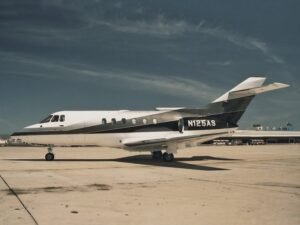





Nigeria’s estimated 240 private jets have reignited questions about economic inequality, regulatory accountability and the country’s struggling aviation industry, particularly as millions of citizens battle poverty without a functional national airline.
The growing private aviation market presents a striking contrast between the country’s wealthy elite and millions of Nigerians struggling to afford basic necessities, including food, healthcare, education and transportation.
In an opinion article by, Daniel Nduka Okonkwo examines the widening gap between luxury and economic hardship, arguing that Nigeria’s expanding private jet market raises important questions about governance, public revenue and national development.
According to figures attributed to Aviation Minister Festus Keyamo, Nigeria’s private jet fleet has grown from 44 aircraft in 2005 to 100 in 2021, 157 in 2024 and approximately 240 in 2026.
The figures reportedly make Nigeria Africa’s largest business aviation market.
Nigeria’s private jet boom
Despite the impressive growth in private aviation, questions remain about aircraft ownership, registration and regulatory compliance.
Industry estimates suggest that approximately 70 per cent of locally based private jets, representing between 165 and 170 aircraft, are registered abroad, while only about 70 to 75 carry Nigeria’s 5N registration.
Flight activity data further illustrate the scale of the market.
Between January 1 and November 11, 2026, business aviation records showed 14,890 private jet departures involving 354 different aircraft registrations.
However, the figure does not represent 354 aircraft permanently based in Nigeria, as the records also include visiting foreign corporate aircraft and VIP airliners.
Heavy jets accounted for 57.1 per cent of recorded departures, with an average flight duration of 64 minutes and a distance of approximately 362 nautical miles.
While these figures raise questions about the use of large aircraft for relatively short journeys, they do not independently establish wastefulness or unlawful operations.
Millions of Nigerians still live in poverty
The expansion of private aviation comes against the backdrop of widespread economic hardship.
The World Bank’s 2026 assessment estimates that 69.6 per cent of Nigerians lived below the $4.20-a-day poverty threshold in 2025.
Similarly, the United Nations Development Programme’s 2026 Multidimensional Poverty Index puts Nigeria’s multidimensional poverty rate at 48.7 per cent, representing approximately 113.3 million people, based on 2024 survey data.
Although the two measurements assess different dimensions of poverty, they underline the economic difficulties facing a significant proportion of the population.
Okonkwo argues that the contrast between the country’s expanding luxury aviation market and widespread poverty deserves closer examination.
Nigeria’s national airline challenge
Another striking feature of Nigeria’s aviation industry is the absence of an operational national airline despite the country’s growing private jet market.
Nigeria Airways stopped operations in 2003 before being liquidated in 2004.
The subsequent Nigeria Air project also failed to commence commercial flight operations.
This leaves questions about the country’s ability to develop a sustainable national carrier capable of strengthening domestic connectivity, supporting economic activities and competing within the international aviation market.
Customs enforcement and private jet compliance
Regulatory enforcement has also emerged as a major concern in Nigeria’s private aviation sector.
In October 2024, the Nigeria Customs Service warned private jet operators to regularise their aircraft documentation.
In June 2025, Customs grounded more than 60 private jets at airports in Lagos and Abuja over alleged violations involving import duties and documentation.
The aircraft were temporarily unsealed on June 4 to allow operators to present the necessary documents.
In another development, a Federal High Court ordered the permanent forfeiture of a Bombardier Global 6000 operated by Orlean Invest Africa Limited.
According to a January 2026 Customs newsletter, the aircraft entered Nigeria in 2015 without a Temporary Import Permit or payment of applicable duties.
Calls for greater transparency and accountability
Against this background, Okonkwo advocates stronger regulatory oversight and greater transparency in the management of Nigeria’s private aviation sector.
He calls on the Nigeria Customs Service to publicly disclose information about detained aircraft, assessed and recovered duties, penalties imposed and outstanding enforcement cases.
The article also urges the Nigerian Civil Aviation Authority to publish information about inspections, suspensions, compliance outcomes and enforcement actions against illegal charter operations.
Additionally, the government is urged to clarify how many of the estimated 240 private jets are locally based and how many operate under foreign registrations.
The author, however, maintains that Nigeria should not punish legitimate wealth creation or discourage lawful investment in private aviation.
Rather, he argues that authorities must enforce existing regulations, close compliance loopholes and ensure that the expanding aviation market contributes fairly to government revenue.
Ultimately, Nigeria’s estimated 240 private jets represent more than an expanding luxury market. They also raise broader questions about economic inequality, public accountability and the country’s ability to translate private wealth into national development.