




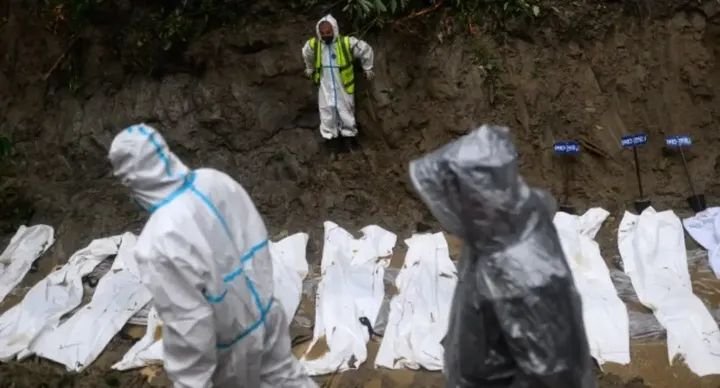
Families in Nepal have begun holding symbolic funeral ceremonies for loved ones still missing after devastating flash floods killed more than 1,000 people across the region.
The ceremonies were held on Tuesday after days of searching hospitals, shelters and morgues for victims of last week’s disaster.
In Kathmandu, 12-year-old Rozel Shrestha set fire to a small effigy made from straw and barley at the Pashupati temple, representing his missing father, 37-year-old Krishna Shrestha.
Krishna was in the worst-hit Rasuwa district when the floods struck on Wednesday and has not been seen since.
“We searched everywhere, went to morgues across the country, but could not find his body,” his brother, Jeevan Shrestha, told AFP.
“So the family sat down… and decided we have to do our traditional rituals to liberate his soul.”
Nearly 4,000 people are missing in Nepal following the collapse of a Himalayan glacier on the border with China, which triggered a tsunami-like wall of freezing water and debris.
The disaster devastated communities along the Nepal-Tibet border and left families facing uncertainty over the fate of thousands of missing relatives.
Families Begin Farewell Rituals
The family of 35-year-old truck driver Chandra Bahadur Newar also held a symbolic funeral.
Newar was in the Nepalese border town of Timure while travelling towards China when the disaster struck. He last spoke to his family the night before the floods.
“He had called after dinner as he always did,” his wife, Dolma Newar Tamang, said. “He had said he would be back in not more than a week.”
When his customary morning call did not come, Tamang initially thought he was simply busy.
“But then I saw the news and called him,” she said. “I called repeatedly, but he never picked up.”
Newar’s relatives searched desperately for him, with some travelling north towards the disaster zone while others searched downstream, where hundreds of bodies had been swept away.
Tamang also visited hospitals and morgues in Kathmandu several times before accepting that her husband might never return.
“We had to do this to set his soul free, so that he is at peace and happy wherever he is,” she said, flanked by her sobbing son.
Nepal Morgues Struggle With Bodies
At a cremation site in Kathmandu, relatives of Mahesh Dangol also prepared to say goodbye.
Dangol, 30, was among the few people rescued from the almost completely destroyed town of Betrawati. He later died from a lung infection in a Kathmandu hospital.
His family delayed his cremation while hoping for news of his parents, wife and daughter, who were swept away by the floods.
However, hospital authorities told the family on Tuesday that they could no longer keep Dangol’s body because they were running out of space, according to his cousin, Sunil Dangol.
More than 1,000 bodies have been recovered by authorities, but only a handful have been identified, putting further pressure on Nepal’s already limited morgue capacity.
“It is unlikely anybody else will be found, so we have decided to go ahead with the rituals for the entire family,” Sunil said.
The symbolic funerals reflect the growing anguish among families as rescue teams continue searching for thousands of people whose whereabouts remain unknown