



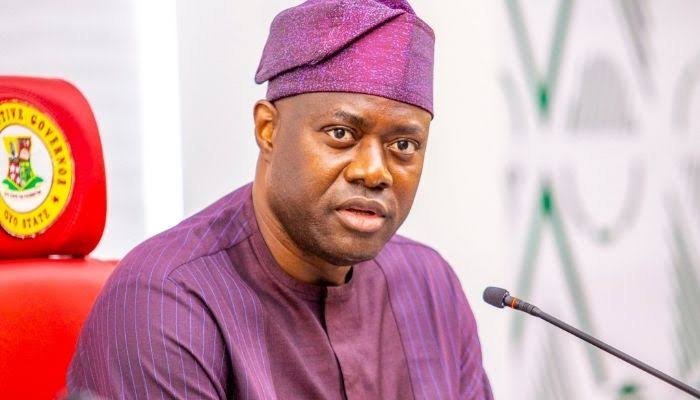
Oyo State Governor and presidential candidate of the Allied Peoples Movement (APM), Engr. Seyi Makinde, has unveiled four major pillars of his proposed Reset Agenda for Nigeria, focusing on the economy, education, security and socio-political development.
Makinde urged Nigerians to become “Resetters”, saying the agenda was designed to address major challenges facing the country and create better opportunities and improved living standards.
He said the initiative was not about blind followership or entitlement, but about ensuring that Nigeria’s “first 11” were in governance.
Four pillars of Makinde’s Reset Agenda
The governor said the four pillars were developed around a central question: what must change to give Nigerians a fair chance to build better lives?
Makinde said his proposed economic reset would focus on reducing structural costs that make living and doing business expensive.
He listed infrastructure development, support for productive sectors and the creation of a more predictable business environment among the priorities.
“Our economic reset will focus on creating the conditions in which people and businesses can produce, earn, invest and grow,” he said.
Makinde said his experience in Oyo State had demonstrated the importance of identifying factors limiting economic activities and deliberately addressing them through infrastructure investment, agribusiness and the development of secondary cities.
He stressed that the goal was not simply economic growth on paper, but ensuring that growth translated into better opportunities and improved living conditions.
Makinde said Nigeria could not build a competitive economy without investing in its people.
He raised concerns over the lack of consistent and current data on out-of-school children and learning outcomes across the country.
According to him, the education system must go beyond enrolling children in schools to determining whether they remain in school and, more importantly, whether they are learning.
“Every child must count — and every child must be counted,” he said.
The governor said his administration had invested in education and taken steps to increase enrolment and improve learning outcomes in Oyo State, while acknowledging that more work remained.
He said the Reset Agenda would address foundational learning, access to education, teacher quality, curriculum development, technical and vocational education, tertiary education, research, funding, measurement and accountability.
Makinde said Nigerians should be able to travel, farm, trade, attend school, worship and live in their communities without constant fear for their lives and livelihoods.
He expressed concern about Nigeria’s position on the Global Terrorism Index, saying the country moved from eighth in 2023 to fourth in 2025.
The governor argued that Nigeria’s security strategy should place greater emphasis on intelligence gathering, early warning, prevention and coordination, rather than responding only after attacks occur.
He also called for stronger relationships between communities and security agencies.
Makinde cited Oyo State’s 615 toll-free emergency line, Security Control Room and City Watch facilities as examples of mechanisms introduced to strengthen security response and intelligence gathering.
“Information is only useful when there is a system capable of receiving it, acting on it and getting help where it is needed,” he said.
On socio-political development, Makinde questioned the extent of federalism in Nigeria and called for a clearer distribution of responsibilities among the federal, state and local governments.
He said the debate should go beyond simply transferring powers from the Federal Government to state governments.
According to him, Nigeria must determine which level of government is best placed to make specific decisions and whether it has the institutions, resources and accountability mechanisms required to deliver effectively.
Makinde also explained his position on local government autonomy, saying financial autonomy could not be considered separately from the structure of Nigeria’s federal system.
He said discussions should also address how local governments were created, their responsibilities and their relationship with state governments.
The socio-political component of the Reset Agenda, he said, would seek to build a federation where responsibilities were clearly defined, decisions were taken at the appropriate level and every tier of government had institutions capable of delivering services and being held accountable.
Makinde links four pillars
The governor said the four pillars were interconnected.
He noted that insecurity could undermine farming and investment, while poor education could limit the development of a productive workforce.
He added that a weak economy could worsen poverty, unemployment and insecurity, while weak institutions could prevent even well-designed policies from producing lasting results.
Makinde said he would provide more details on each pillar in the coming weeks, including the evidence behind the proposed policies, specific changes being proposed and how implementation would be measured.
He said his experience governing Oyo State would also form part of the discussion, including areas where his administration had recorded progress and those where more work remained.
According to Makinde, the ultimate objective is to ensure that the Reset Agenda goes beyond a political slogan and provides practical answers on what would change and how those changes would improve Nigerians’ lives.