




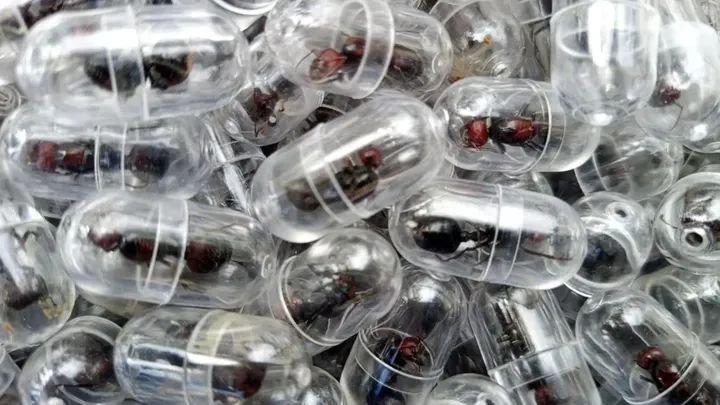
A Chinese national has been arrested at Kenya’s busiest airport after authorities discovered more than 2,000 live queen garden ants hidden in his luggage in an alleged wildlife trafficking attempt.
The suspect, Zhang Kequn, was intercepted during a security check at Jomo Kenyatta International Airport in Nairobi, according to prosecutors.
Investigators said the ants were being transported to China and were carefully concealed in test tubes and rolls of tissue paper inside his luggage.
A prosecutor told the court that officers discovered 1,948 garden ants packed in specialised test tubes, while another 300 live ants were hidden in three rolls of tissue paper.
“These were recovered from his personal luggage during the inspection,” state prosecutor Allen Mulama said during court proceedings on Wednesday.
Authorities say the ants are giant African harvester ants, scientifically known as Messor cephalotes, a species protected under international biodiversity agreements.
Officials believe the insects were destined for exotic pet collectors in Europe and Asia, where demand for rare ant colonies has surged in recent years.
Wildlife trafficking investigation widens
Kenyan authorities suspect Zhang may be linked to a wider ant-trafficking network.
The court granted investigators five days to detain him while detectives examine his phone and laptop for evidence.
According to Kenya Wildlife Service official Duncan Juma, further arrests are likely as investigators expand the probe to other towns where ant harvesting may be taking place.
Wildlife officials say removing large numbers of queen ants could severely damage ecosystems.
Queen ants are essential to colony survival and play a critical role in soil aeration and biodiversity.
Previous ant-smuggling case
The arrest comes months after a landmark wildlife trafficking case in Kenya.
In May last year, a Kenyan court sentenced four men, two Belgians, a Vietnamese national and a Kenyan to one year in prison or a $7,700 fine for attempting to smuggle thousands of live queen ants out of the country.
The Kenya Wildlife Service described the ruling as a significant victory against wildlife trafficking.
Officials warned that the growing international demand for exotic insects could threaten fragile ecosystems if illegal harvesting continues.