




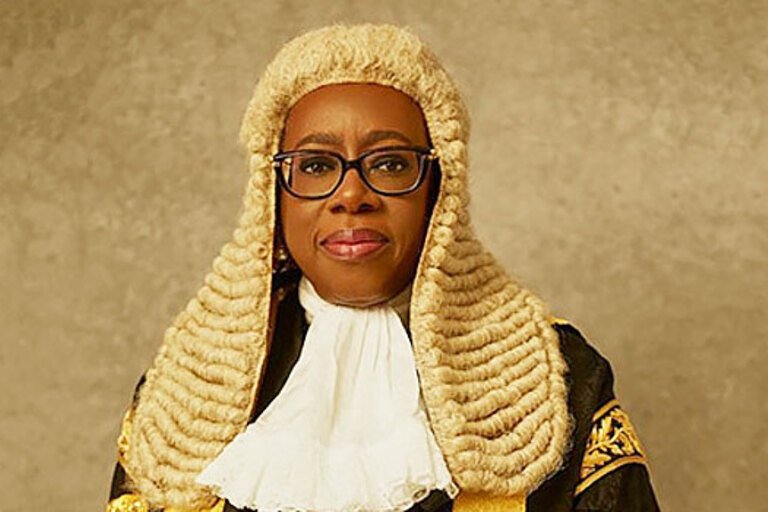
Justice Kudirat Kekere-Ekun was screened and confirmed as the substantive Chief Justice of Nigeria (CJN) by the Senate on Wednesday.
Godswill Akpabio, the Senate President, announced Kekere-Ekun’s confirmation at plenary after she was cleared by voice vote.
The 66-year-old jurist is Nigeria’s 23rd substantive Chief Justice and the second woman to hold the position.
The new Chief Justice was grilled for about two hours by parliamentarians, who questioned her on a variety of issues, including judiciary reforms.
Senators cleared Kekere-Ekun in the Committee of the Whole.
The confirmation was made under Section 231 (1) of the 1999 Constitution, as amended.
Following the confirmation, Akpabio expressed confidence that Nigeria will receive proper justice under the leadership of Kekere-Ekun as the new CJN.
Following the confirmation, Akpabio expressed confidence that Nigeria will receive proper justice under the leadership of Kekere-Ekun as the new CJN.
The Senate President then welcomed the new CJN and encouraged her to maintain the integrity of the Nigerian courts.
During her screening, Justice Kerere-Ekun stressed her absolute opposition to corruption in the courts, emphasising that she would not tolerate any form of it.
She read the riot act to judicial officers, emphasising that she would not accept corruption, frivolous ex parte orders, and interim injunctions, which are frequently given by some judges.
To alleviate the backlog of cases at the Supreme Court, she urged the Senate, and by extension, the National Assembly, to change the relevant portion of the 2022 Electoral Act to require all pre-election concerns to be resolved at the Court of Appeal.
She said that difficulty lies for individuals who discuss matters that are still proceeding in court, particularly senior lawyers who make declarative or authoritative comments that verge on sub-judice.
She said, “Some of the things that I’m known for are integrity and zero tolerance for corruption.
“The judiciary, under my leadership as CJN, will be one that is not associated with corruption and other things like frivolous ex parte orders by judges or interim injunctions.
“Decisive actions would be taken against any officer found indulging in such practices.
“Powers on ex parte orders and interim injunctions are no doubt being abused by some judges. Such abuses would not be tolerated under my headship of the judiciary.”
Speaking on conflicting court judgements, the newly-confirmed CJN said digitisation of all courts would help to tackle cases and stem the problem.
“Digitalisation of all the courts would help to track cases already treated by the various courts and prevent conflicting judgements,” she noted.
Justice Kekere-Ekun stated that for the Supreme Court, all pre-election matters should be resolved in the Court of Appeal.
She went on to say that Alternative Dispute Resolution would be utilised to decongest cases at various courts, which many people will welcome because it avoids victorious and vanquished pronouncements.
Responding to allegations of subjudice committed by social commentators, particularly senior lawyers, on television and radio programs through declarative or authoritative comments on cases pending in the courts, the CJN stated that as Chairman of the Legal Practitioners Privileges Committee, such actions would be addressed.
She added, “Decisive actions would, no doubt, be taken against those found of making declarative or authoritative comments on cases pending in the courts of law.”
However, Kekere-Ekun disagreed with the suggestion made by Senator Sani Musa that separate courts should be created to handle election matters and terrorism, saying, “Such courts would also be congested later if the required digitalisation of courts across the country is not done.”