




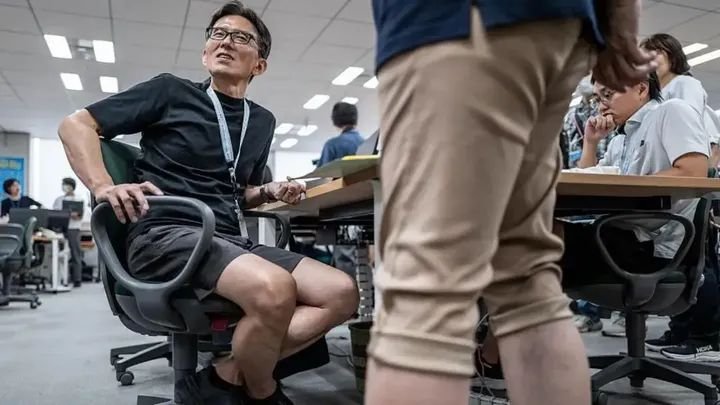
Japan’s push for cooler office wear during the scorching summer months is sparking debate, with more men turning up to work in shorts as temperatures continue to climb.
The Tokyo Metropolitan Government has encouraged workers to swap traditional suits and ties for lighter clothing, including T-shirts, trainers and shorts, under its expanded Tokyo Cool Biz campaign introduced by Governor Yuriko Koike in April.
The initiative builds on the long-running Cool Biz programme, launched in 2005 to reduce energy consumption by encouraging office workers to dress more casually during summer.
Nearly four months after the updated guidance took effect, reactions remain divided.
While many employees welcome the relaxed dress code as a practical response to extreme heat, critics argue the policy exposes double standards. Although not an official rule, women in many traditional Japanese workplaces are still expected to wear tights when their legs are visible, leading some to question why men now enjoy greater flexibility.
Others have raised concerns over what has become known online as “sunehara”, or “leg hair harassment”, describing the discomfort of seeing male colleagues’ leg hair in the office.
“We want to give people more options in the severe heat, not tell them what to wear. There should be no issue as long as the work attire is not offensive to anyone,” Tokyo Metropolitan Government environmental official Noboru Watanabe told the BBC.
A June survey by Gorilla Clinic found that 53.5% of respondents opposed wearing shorts to work, while 46.5% supported the recommendation.
Among those against the trend, concerns centred on body shape and body hair. The survey also found women were more likely than men to object to colleagues wearing shorts.
Akifumi Funatsu, director of Gorilla Clinic, said more men are seeking laser hair removal before wearing shorts to work, describing it as an issue of workplace etiquette rather than personal appearance.
The renewed focus on lighter office clothing comes as Japan battles another summer of record-breaking temperatures. Weather authorities have warned of extreme heat, introducing the term “kokusho-bi” to describe days when temperatures exceed 40°C.
According to the Fire and Disaster Management Agency, seven people died from heatstroke and 4,580 others were hospitalised during the week of 6–12 July.
Officials continue to advise residents to stay hydrated, use air conditioning where possible and prepare for the heat through gradual acclimatisation. Demand has also surged for cooling products such as fan-equipped clothing, portable handheld fans, UV-blocking umbrellas and disposable cooling towels.