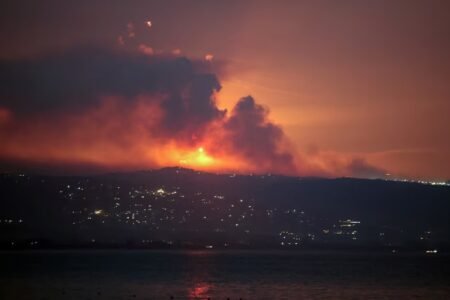




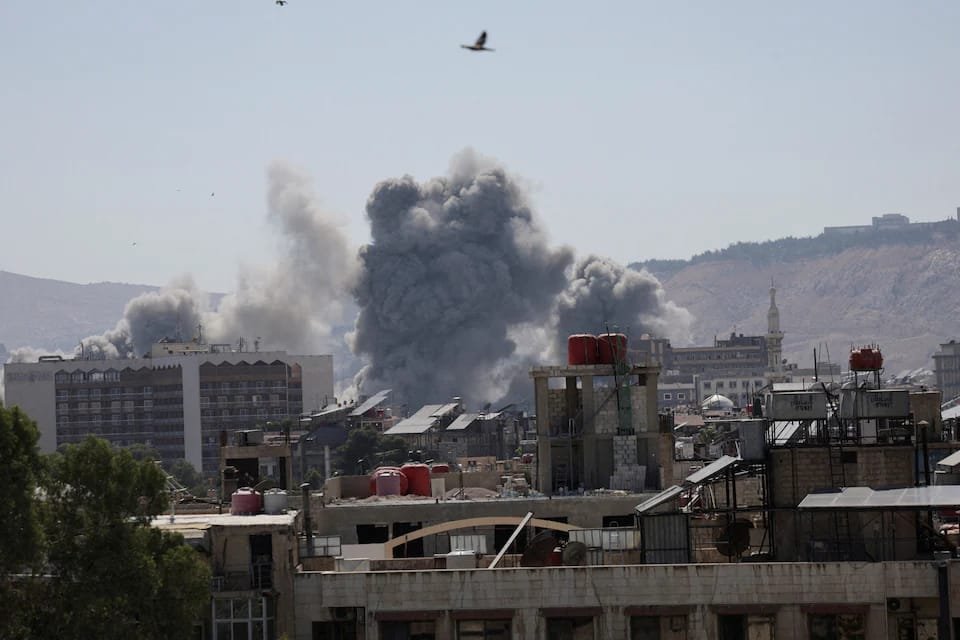
On Wednesday, Israel launched intense airstrikes in Syria’s capital, Damascus, hitting strategic military locations, including part of the defence ministry and an area near the presidential palace.
The operation comes as Israel declares its resolve to shield the Druze minority in southern Syria, calling for the withdrawal of Syrian government forces.
The strikes mark a dramatic escalation by Israel against the Islamist-led administration of interim Syrian President, Ahmed al-Sharaa, despite his recent diplomatic overtures toward the United States and developing security discussions with Israel.
Describing the Syrian leadership as “barely disguised jihadists”, Israeli officials reiterated they would not allow hostile forces to entrench themselves in southern Syria. The action follows calls from Israel’s Druze citizens urging the government to protect their ethnic kin across the border.
The United States responded by signaling that a resolution was near. “We have engaged all the parties involved in the clashes in Syria. We have agreed on specific steps that will bring this troubling and horrifying situation to an end tonight,” said U.S. Secretary of State, Marco Rubio.
The United Nations Security Council is scheduled to meet Thursday to address the conflict. Israeli Ambassador to the U.N., Danny Danon, said, “The council must condemn the barbaric crimes committed against innocent civilians on Syrian soil. Israel will continue to act resolutely against any terrorist threat on its borders, anywhere and at any time.”
Airstrikes rock Damascus
Residents in Damascus reported hearing warplanes flying low over the city in the afternoon, followed by several powerful explosions. Thick plumes of smoke were seen rising from the defence ministry, where part of the structure was reduced to rubble. A medical source in Syria confirmed that five security personnel were killed in the strike.
An Israeli military official stated that the air force targeted the entrance of Syria’s military headquarters and another military site near the presidential palace. According to the official, the Syrian regime has failed to prevent or address attacks against Druze civilians.
“We will not allow southern Syria to become a terror stronghold,” said Eyal Zamir, Israel’s military chief of staff.
President Sharaa, struggling to maintain national unity, continues to face resistance from various ethnic and religious factions, particularly amid fears of growing Islamist dominance. Mass killings of Alawite minorities in March have only deepened sectarian distrust.
Sweida violence intensifies
The airstrikes come as Sweida, a Druze-majority city in southern Syria, is engulfed in deadly clashes involving government troops, Druze fighters, and Bedouin tribesmen. Syrian troops had moved into the region earlier in the week but soon clashed with local Druze militias.
Despite reports of a ceasefire announced by Syria’s interior ministry and Druze leader, Sheikh Yousef Jarbou, fresh fighting erupted in the city. A Reuters witness reported renewed gunfire and explosions, with residents trapped inside their homes.
“We are surrounded and we hear the fighters screaming … we’re so scared,” said a man in Sweida via phone. “We’re trying to keep the children quiet so that no one can hear us,” he added, declining to be named due to safety concerns.
Syria’s health ministry reported that dozens of civilian and fighter bodies were found in a local hospital. While the Syrian Network for Human Rights placed the death toll at 169, security officials said as many as 300 people may have died. These figures have not been independently confirmed by Reuters.
Druze solidarity across borders
The Druze, who follow a religion with roots in Islam, reside primarily in Syria, Lebanon, and Israel. Following public appeals, several Israeli Druze crossed the border fence into Syria to support their community, according to eyewitness accounts.
Israeli Prime Minister, Benjamin Netanyahu, addressed the situation, saying, “The Israeli military was working to save the Druze” and appealing to Israeli Druze citizens not to cross the border. The Israeli Defence Forces said efforts were underway to safely return the civilians who had crossed.
One Israeli Druze man, Faez Shkeir, expressed deep anguish over the ongoing violence. “My family is in Syria – my wife is in Syria, my uncles are from Syria, and my family is in Syria, in Sweida, I don’t like to see them being killed. They kicked them out of their homes, they robbed and burned their houses, but I can’t do anything,” he said.
A Reuters journalist on the ground reported witnessing government forces looting homes in Sweida, stealing cars, furniture, and setting residences ablaze. One local man showed the body of his brother, who had been shot in the head inside their house.
In response, the Syrian government issued a statement promising to hold those responsible for unrest in Sweida accountable and reaffirming its commitment to protecting all Syrian citizens. Interim President Sharaa has also reiterated his pledge to safeguard minority communities.