


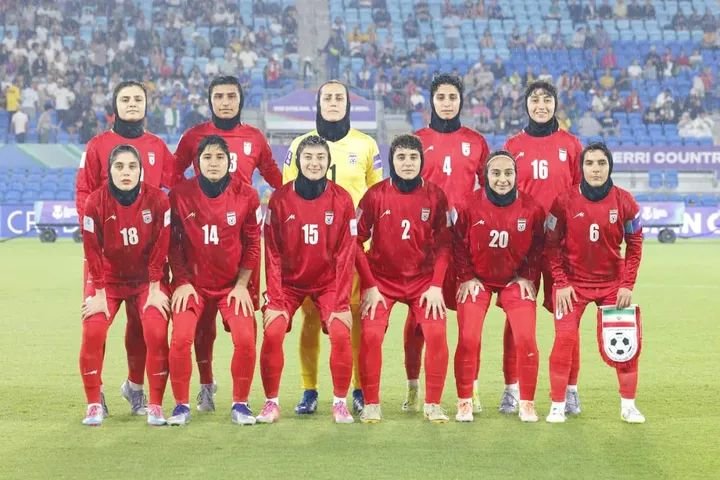
Several members of the Iran women’s national football team have refused to return home after competing in the AFC Women’s Asian Cup in Australia, fearing possible execution following death threats linked to a political protest.
Reports say some players declined to board a flight back to Iran after refusing to sing the national anthem during their opening match of the tournament.
The protest reportedly came just two days after strikes on Iran by the United States and Israel, placing the players under intense scrutiny from Iranian authorities.
Players seek asylum in Australia
According to reports, five players — including the team captain — escaped from their handlers on Monday night and requested protection from Australian authorities.
Australia’s Home Affairs Minister, Tony Burke, confirmed on Tuesday that the women had been granted humanitarian visas and moved to a safe house.
Two additional players also sought asylum shortly before their scheduled flight from Sydney to Iran via Kuala Lumpur.
One of the players, winger Golnoosh Khosravi, reportedly refused to board the aircraft at the departure gate while activists protested the team’s return to Iran.
During the protest, a demonstrator held a sign written in Farsi reading: “Golnoosh, your mum said to stay.”
Another player, Mohadeseh Zolfi, also reportedly requested asylum before the flight, according to Iran International.
Emotional scenes at the airport
Witnesses said several players appeared visibly distressed as the rest of the team boarded the aircraft.
Some were reportedly crying, while one player was seen dragging a teammate toward the transport vehicle that ferried them to the plane.
The team popularly known as Iran’s “Lionesses” had already been branded “wartime traitors” by Iranian state media after their silent protest during the anthem on March 1.
Their action was widely interpreted as a political statement following reports of the killing of Iran’s Supreme Leader, Ali Khamenei.
Fears of punishment on return to Iran
Human rights organisations warn the players who return to Iran could face serious consequences.
Skylar Thompson, deputy director of Human Rights Activists, said the athletes could face interrogation, travel bans or suspension from sport.
However, some reports suggest harsher penalties could follow.
Sources told IranWire that the Islamic Revolutionary Guard Corps (IRGC) was considering charges including “cooperation with a hostile state” and “propaganda against the regime”.
Authorities are also accused of threatening the players’ families, with some relatives reportedly detained.
Message from home influenced escape
Players who have already been granted asylum reportedly include Zahra Ghanbarim, Fatemeh Pasandideh, Zahra Sarbali, Atefeh Ramazanzadeh and Mona Hamoudi.
Their decision to flee was reportedly influenced by a message smuggled out of Iran via Turkey urging them to remain abroad.
Trump reacts to asylum decision
US president Donald Trump initially criticised Australia for allowing the team to return home, urging the government to grant asylum instead.
He later retracted the criticism after learning that the Australian government under Prime Minister Anthony Albanese had already provided refuge for several players.
“He’s on it,” Trump wrote on Truth Social. “Five have already been taken care of, and the rest are on their way.”
Players reportedly under tight surveillance
Australian media reported that during the tournament the players were closely monitored by officials believed to be linked to the IRGC.
The athletes were reportedly denied access to mobile phones and had their movements tightly controlled.
After the team’s elimination on Sunday, crowds gathered around the team bus chanting “Let them go” and “Save our girls”.
One player was also seen signalling “SOS” in sign language through the bus window.
Activists have since called on Australian authorities to arrest the team’s handlers and prevent the players from being forced onto flights back to Iran.